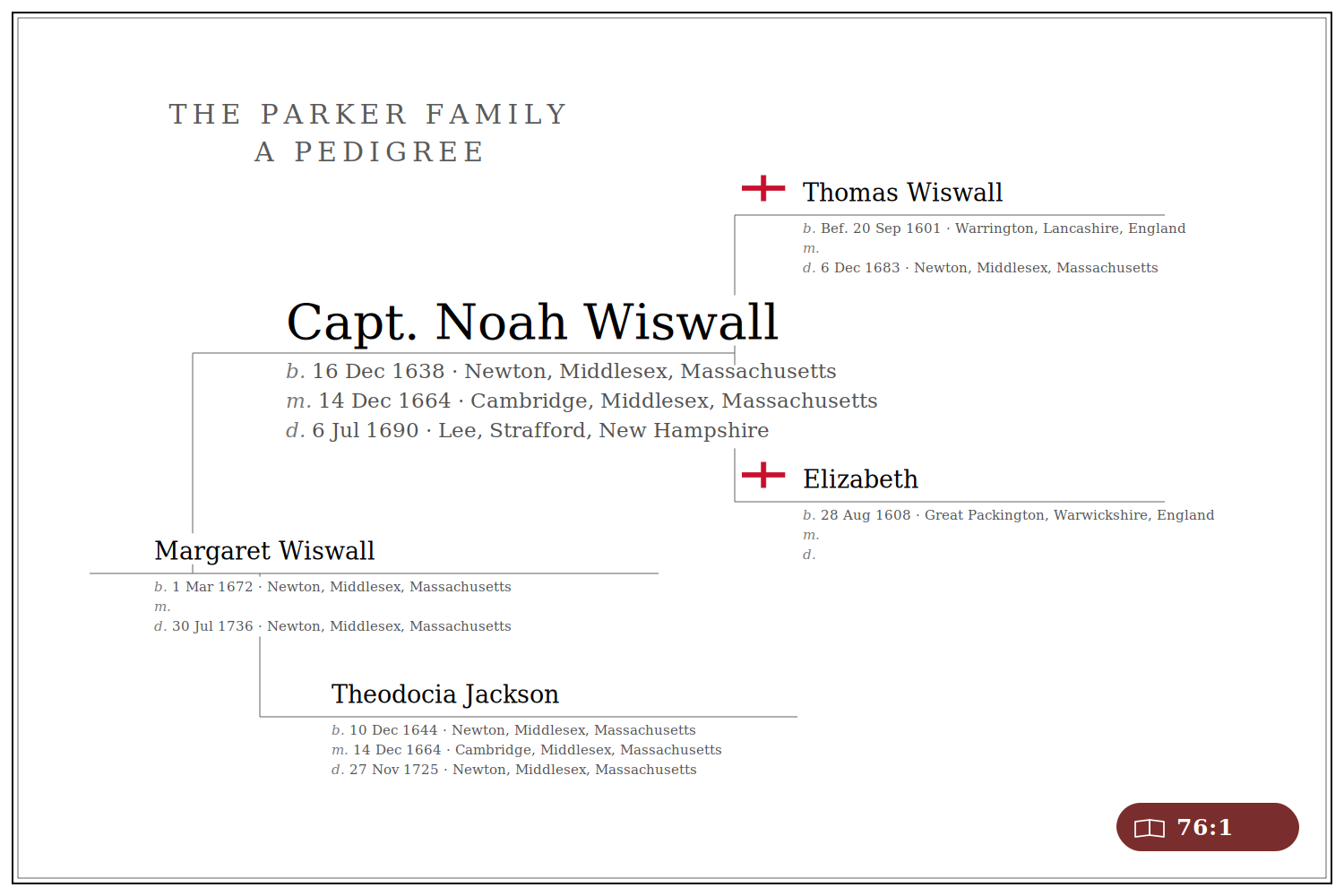
Capt. Noah Wiswall (1638–1690) was fifty-one years old and had ten children the summer Massachusetts asked him to walk into the woods and go to war one more time.
He said yes.
He was a generation past the age when a man is expected to do this, he had a farm in what’s now Newton and a wife and a houseful of kids, and when the colony raised two companies to chase a French and Abenaki raiding party north, Noah took one of them.
It was King William’s War — the European powers had decided to be at war again, which on the New England frontier meant France arming the Abenaki and the Abenaki fighting to keep the English from spreading any further across their lands.
On 4 July 1690 a raiding party hit Exeter. Exeter held. The party fell back and made camp on the shore of a pond named for the Rev. John Wheelwright, in what is now Lee, New Hampshire. Those two Massachusetts companies went after them — one under Capt. John Floyd, one under Noah.
His scouts found the trail at first light on 6 July. The militia came down on the camp and the thing turned into what the old accounts called “a running fight through the woods, after the Indian fashion.” When it was over, three officers and fifteen men were dead — Noah among them, along with his lieutenant Gershom Flagg and his ensign Edward Walker.
And one of his sons. John Wiswall was about twenty years old and in his father’s company that morning, and he died there too.
Theodocia Jackson Wiswall, forty-seven years old, buried her husband and her son on the same day, with five children still living and the youngest fourteen. She remarried four years later, the required next step for a woman of that time after doing the arithmetic of how to stay alive.
The aftermath has its own grim comedy, if you want it. Floyd kept the field for hours after Noah fell, until enough of his men were dead or bleeding that he pulled the rest out — and was promptly second-guessed by people who weren’t there, for not staying longer.
Capt. James Convers rode out at sunrise the next morning, found seven of the wounded still alive in the woods, carried them to a hospital, then went back to bury everyone else.
The Charter
By strange coincidence, while Noah was dying in those woods for Massachusetts Bay, his older brother was in London, losing a different fight to the same colony. The Rev. Ichabod Wiswall was the minister of Duxbury, Ma., down in Plymouth Colony.
In February of 1690 — months before Noah marched — Plymouth scraped together the money to send Ichabod across the Atlantic to plead for a royal charter. Little Plymouth had never had one, and without it the colony was a legal ghost, eyeballed by its bigger neighbors. Ichabod went to London essentially to keep Plymouth on the map.
On the other side was Increase Mather — the heaviest minister in New England — who was working the same court for the opposite result: fold Plymouth into Massachusetts Bay and be done with it.
Two reverends from Dorchester, arguing over a colony’s life in front of the Crown. Mather won. The 1691 charter erased Plymouth and handed it to the Province of Massachusetts Bay — a hostile takeover with a king’s signature on it.
One Wiswall brother dies in a Massachusetts Bay company defending Massachusetts Bay’s frontier. The other watches Massachusetts Bay swallow the colony he’d crossed an ocean to save. Both Wiswalls lost to the same flag in the same eighteen months.
The Monument
Newton put up a monument to its first settlers, and Noah is on it: “Capt. Noah, of the expedition against Canada, killed in battle with the French and Indians, 1690. Leaving a son Thomas.”
Not to be salty, but Noah’s daughter Margaret is the reason I’m here. She married a Parker and carried the line out of that grief and down to me.
He went into the woods at fifty-one and didn’t come back, and somewhere in the wreckage of that summer is a girl who would grow up and marry, ensuring her father was somebody’s ancestor instead of only a name carved on the south side of that monument.
Yet the monument speaks of the son but fails to mention the daughter.
Sources. The Wiswall Genealogy — descent and the Newton, Massachusetts marriage to Theodocia Jackson, 1664. WikiTree (Wiswall) and the Newton Vital Records — Noah’s children, including John, killed beside him, and the eldest son Thomas, named on the First Settlers Monument. Contemporary accounts of the Wheelwright’s Pond fight, 6 July 1690, and of Ichabod Wiswall’s charter agency in London.
Podcast: Play in new window | Download