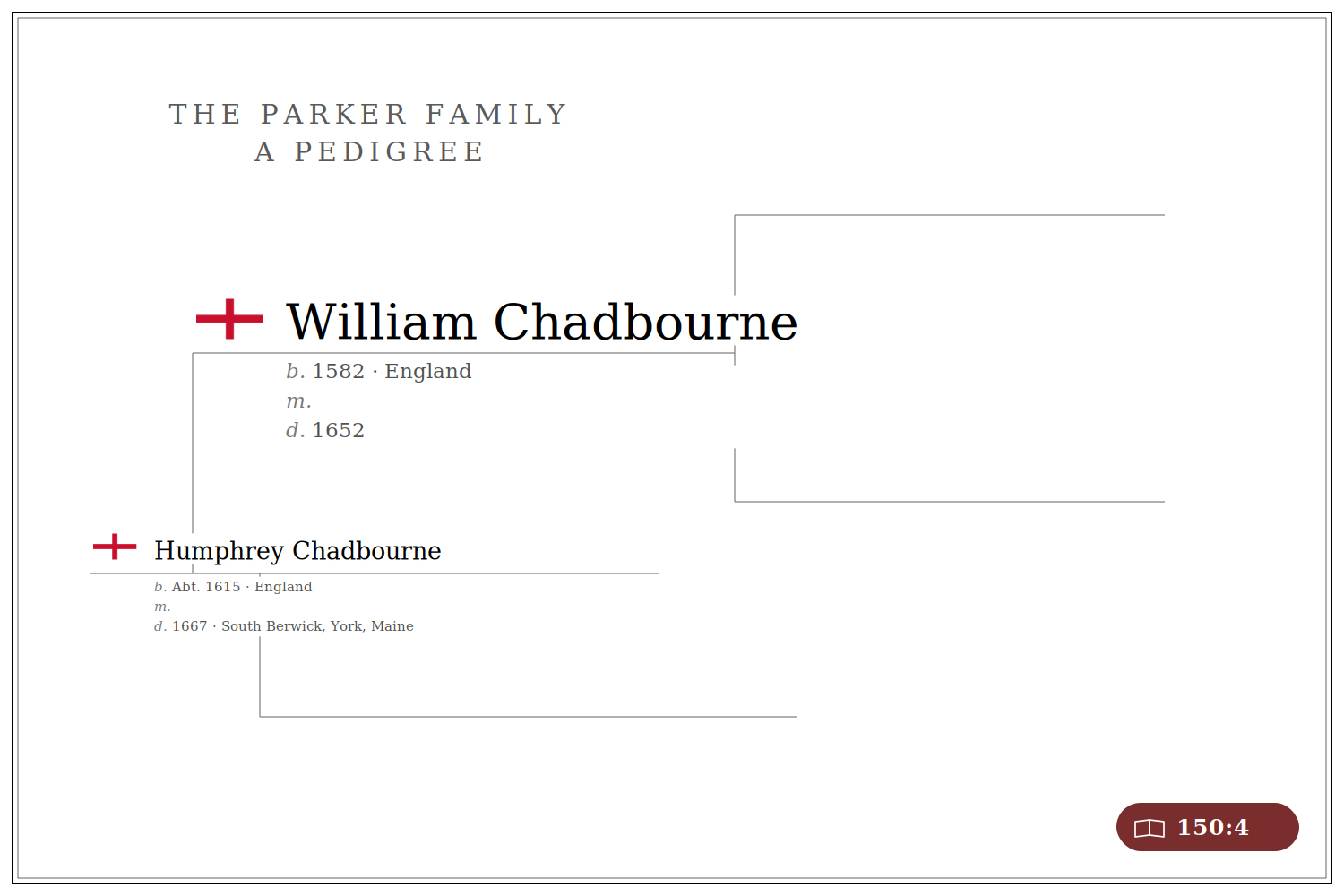
Most of my ancestors crossed an ocean for God. William Chadbourne crossed it for a paycheck. He was a carpenter — a housewright, in the period word, the man you hired to frame a building and have it still be standing the following winter.
On 16 March 1634 he put his name to a contract with Captain John Mason’s Laconia Company, a London joint-stock outfit chasing profit on the New England coast. The deal was to come to Berwick, build a sawmill and a grist mill, run them on shares for five years, and at the end walk away with fifty acres on a long lease for three bushels of corn a year.
William said “hey, why not?” then boarded a ship called the Pied Cow with two other carpenters — James Wall and John Goddard — and landed at the falls in July 1634. The Chadbournes were Church of England, not dissenters. They hadn’t come to build a shining city on a hill, they’d come to build a mill on a river.
Two weeks off the boat, they started cutting timber at the falls the Wabanaki called Asbenbedick, and what they put up there is, by the honest accounting, the first water-powered sawmill in New England. (Occasionally, people call it the first sawmill in America, but that seems a stretch given Jamestown/1607 wasn’t exactly built with bricks.)
He had done his homework before getting here. In 1631 a letter out of London notes a scale model of a sawmill going across on an earlier voyage — a little wooden demo of the thing, sent ahead so the men on the ground would know what they were looking at when the real mill went up.
So New England’s first sawmill arrived the way a lot of things still do: as a demo unit, shipped across the Atlantic to an audience you could fit in one boat. Some assembly required, carpenter sold separately, arriving 1634.
And then the thing he built became the blueprint of the engine that drove the entire region. Those falls became the center of the regional lumber trade: the boards that framed Portsmouth and Kittery and the Berwicks, the masts that went out to the Royal Navy, came off mills built and rebuilt at the gorge for generations.
He didn’t found a colony. He built the machine the colony grew up around. He just wasn’t around to see it.
Mason died. The Laconia Company lost its money and its nerve. And William Chadbourne … disappeared. He has no death record. Not in Maine, not in England. The last time the paperwork sees him is a petition at Kittery on the twentieth of December, 1652. That’s not a death date. That’s a last-seen. He deeded his homestead to his son-in-law and walked off the edge of the documentation, presumably back to England for a quiet death, but honestly we have absolutely no clue.
In 1651 the town of Kittery granted the privilege at the falls to Richard Leader, late of the Saugus Iron Works, who took over the site and staffed it with Scotsmen — Dunbar prisoners, shipped over as bonded labor after Cromwell broke their army. Leader put in a gang of up to twenty saws, and it was his bigger operation, not William’s, that gave the place and the river the name they still carry: Great Works.
Most of my ancestors crossed an ocean for God, and they got the sermons and the meetinghouses and the Thanksgiving. William Chadbourne crossed it on a contract, built the one structure the region couldn’t have done without, and left before the paint dried.
History remembers the pilgrims. The town remembers the sawmill.
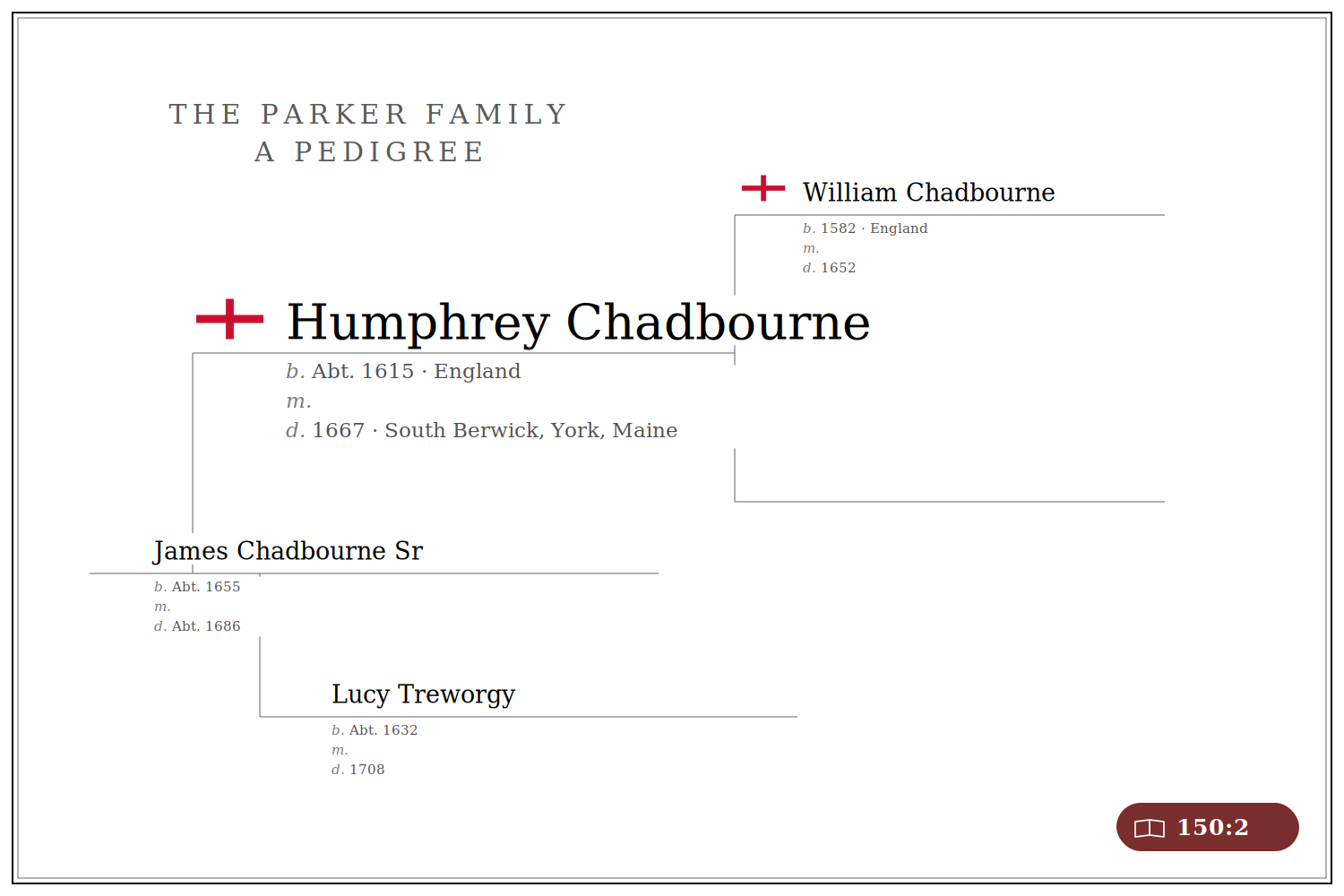
Sources. The 16 March 1633/4 Laconia Company contract and the Pied Cow‘s July 1634 arrival, via the Chadbourne family genealogy and the Old Berwick Historical Society. James Wall’s deposition of 21 May 1652 — the primary record for the building and running of the mill at Asbenbedick (later Great Works) falls. Francis Small’s 1685 deposition for the “first in New England” priority. The 1631 sawmill-model letter from the Laconia Company papers. The Genealogical Dictionary of Maine and New Hampshire (Noyes, Libby, Davis) for the Chadbourne family and the descent through Humphrey. The Richard Leader grant of 1651 and the Dunbar prisoners from York County and Kittery records, and the Old Berwick Historical Society’s “Great Works” history for Leader’s expansion and the name.
Podcast: Play in new window | Download