Tag: England

  • Some Assembly Required: William Chadbourne (~1582–)

    Some Assembly Required: William Chadbourne (~1582–)

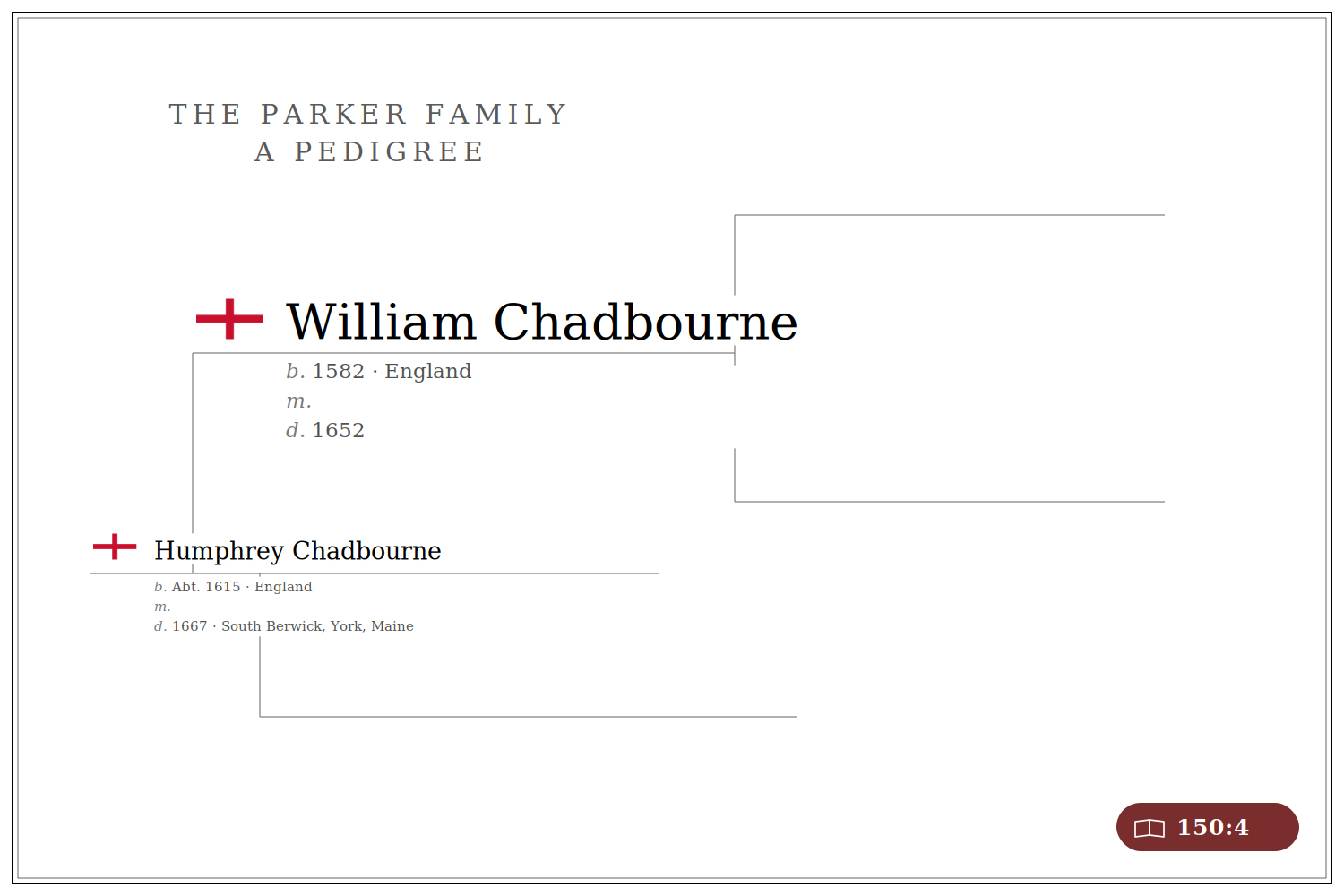
    Most of my ancestors crossed an ocean for God. William Chadbourne crossed it for a paycheck. He was a carpenter — a housewright, in the period word, the man you hired to frame a building and have it still be standing the following winter.

    On 16 March 1634 he put his name to a contract with Captain John Mason’s Laconia Company, a London joint-stock outfit chasing profit on the New England coast. The deal was to come to Berwick, build a sawmill and a grist mill, run them on shares for five years, and at the end walk away with fifty acres on a long lease for three bushels of corn a year.

    William said “hey, why not?” then boarded a ship called the Pied Cow with two other carpenters — James Wall and John Goddard — and landed at the falls in July 1634. The Chadbournes were Church of England, not dissenters. They hadn’t come to build a shining city on a hill, they’d come to build a mill on a river.

    Two weeks off the boat, they started cutting timber at the falls the Wabanaki called Asbenbedick, and what they put up there is, by the honest accounting, the first water-powered sawmill in New England. (Occasionally, people call it the first sawmill in America, but that seems a stretch given Jamestown/1607 wasn’t exactly built with bricks.)

    He had done his homework before getting here. In 1631 a letter out of London notes a scale model of a sawmill going across on an earlier voyage — a little wooden demo of the thing, sent ahead so the men on the ground would know what they were looking at when the real mill went up.

    So New England’s first sawmill arrived the way a lot of things still do: as a demo unit, shipped across the Atlantic to an audience you could fit in one boat. Some assembly required, carpenter sold separately, arriving 1634.

    And then the thing he built became the blueprint of the engine that drove the entire region. Those falls became the center of the regional lumber trade: the boards that framed Portsmouth and Kittery and the Berwicks, the masts that went out to the Royal Navy, came off mills built and rebuilt at the gorge for generations.

    He didn’t found a colony. He built the machine the colony grew up around. He just wasn’t around to see it.

    Mason died. The Laconia Company lost its money and its nerve. And William Chadbourne … disappeared. He has no death record. Not in Maine, not in England. The last time the paperwork sees him is a petition at Kittery on the twentieth of December, 1652. That’s not a death date. That’s a last-seen. He deeded his homestead to his son-in-law and walked off the edge of the documentation, presumably back to England for a quiet death, but honestly we have absolutely no clue.

    In 1651 the town of Kittery granted the privilege at the falls to Richard Leader, late of the Saugus Iron Works, who took over the site and staffed it with Scotsmen — Dunbar prisoners, shipped over as bonded labor after Cromwell broke their army. Leader put in a gang of up to twenty saws, and it was his bigger operation, not William’s, that gave the place and the river the name they still carry: Great Works.

    Most of my ancestors crossed an ocean for God, and they got the sermons and the meetinghouses and the Thanksgiving. William Chadbourne crossed it on a contract, built the one structure the region couldn’t have done without, and left before the paint dried.

    History remembers the pilgrims. The town remembers the sawmill.

    Sources. The 16 March 1633/4 Laconia Company contract and the Pied Cow‘s July 1634 arrival, via the Chadbourne family genealogy and the Old Berwick Historical Society. James Wall’s deposition of 21 May 1652 — the primary record for the building and running of the mill at Asbenbedick (later Great Works) falls. Francis Small’s 1685 deposition for the “first in New England” priority. The 1631 sawmill-model letter from the Laconia Company papers. The Genealogical Dictionary of Maine and New Hampshire (Noyes, Libby, Davis) for the Chadbourne family and the descent through Humphrey. The Richard Leader grant of 1651 and the Dunbar prisoners from York County and Kittery records, and the Old Berwick Historical Society’s “Great Works” history for Leader’s expansion and the name.

  • Bad Fortune: William Hilton the Elder (1591–1655)

    Bad Fortune: William Hilton the Elder (1591–1655)

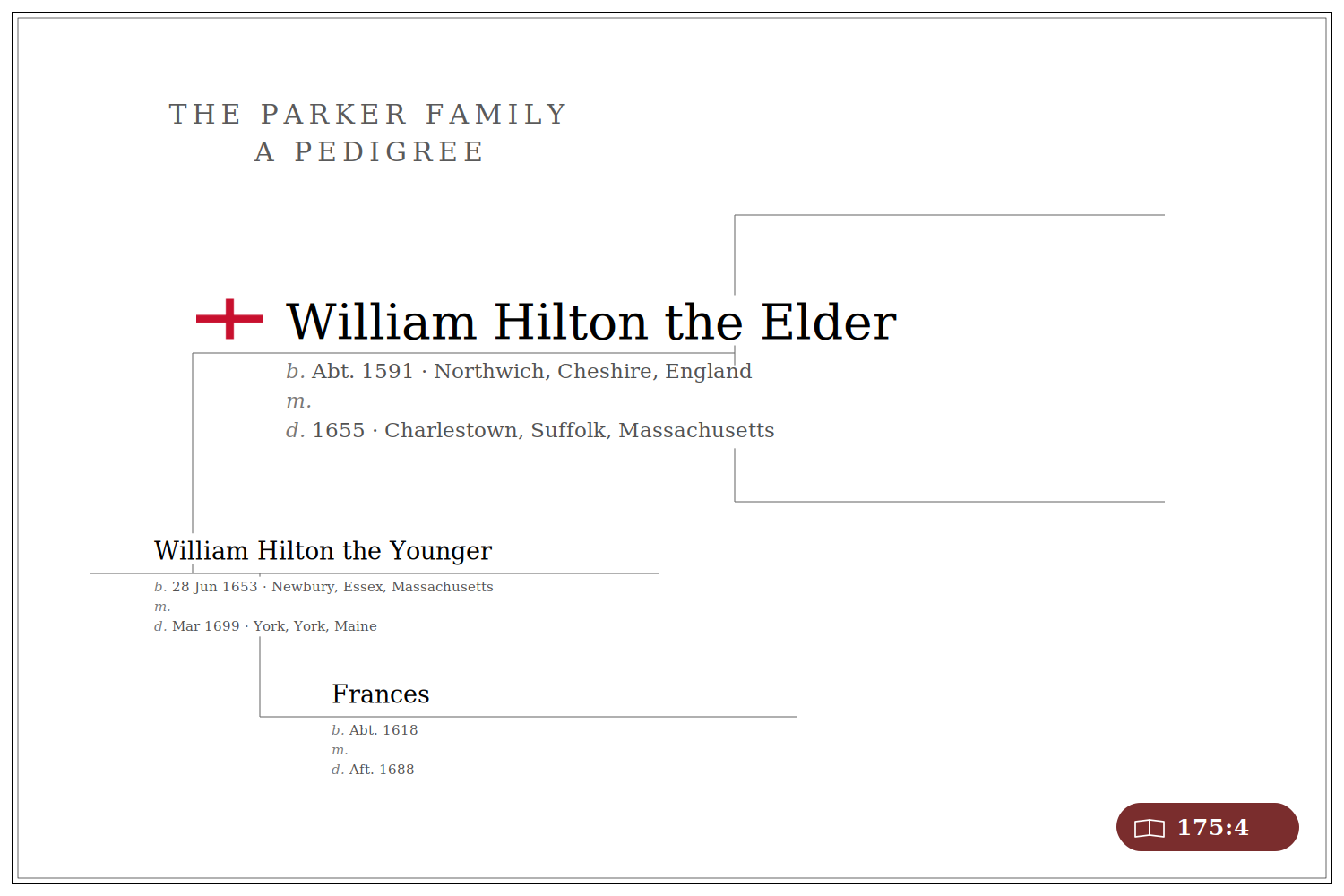
    William Hilton came to America in 1621, on the second ship to Plymouth.

    Never heard about Plymouth’s second ship? You’re not alone — almost nobody has, and once you know what happened, you’ll understand why.

    The ship was called the Fortune, which is the kind of name you give a ship before anything has gone wrong yet.

    It arrived a year late. The Mayflower landed in 1620, but the Fortune didn’t drop anchor off Cape Cod until 9 November 1621, missing, by weeks, the harvest feast that would eventually get rebranded as the first Thanksgiving.

    It was smaller. Much smaller. About a third the size of the Mayflower, and it carried roughly thirty-five new colonists, mostly young single men, into a settlement that had buried half its people the previous winter.

    And here is the part that tells you everything about the men who financed the voyage: they sent thirty-five new mouths and no food. None. Governor Bradford, who was not a man given to comedy, sat down and recorded for posterity that there was “not so much as a biscuit-cake” for the new arrivals, no bedding beyond “some sorry things” in their cabins, and “nor pot, nor pan, to dress meat in.” The ship hadn’t even been provisioned to feed its own crew on the trip home.

    Plymouth did the math, put everyone on half rations, and worked out that the corn would last about six months if nobody got greedy. The colony’s reward for surviving its first year was thirty-five strangers and a hunger problem.

    That could be considered the best outcome. It nearly went worse.

    The Fortune loitered around the tip of the Cape long enough that the colonists decided it was a French raider come to murder them, and Bradford convened a council of war. Myles Standish — the colony’s tiny, perpetually furious military officer — mustered every man and boy who could hold a gun and had the cannon up on Fort Hill fire a warning shot. The ship then ran up the red cross of England, everyone exhaled, and Plymouth narrowly avoided opening fire on the reinforcements it had spent a year praying for.

    The Fortune’s fortune didn’t get much better. While in port, the colonists spent two weeks cramming the hold with everything that might pay down their debt to their English investors — beaver and otter pelts, sassafras, split-oak clapboard. Somewhere around £500 of goods were packed in the ship for the trip back, enough to cut what they owed in half. The ship sailed for London on 13 December 1621 carrying the first real value the colony had ever produced.

    It never got there.

    A navigation error put the Fortune on the coast of France instead of in the English Channel, where a French warship took it on 19 January 1622, held everyone aboard for about a month, and helped itself to the Fortune’s entire cargo.

    The ship limped into London in February with an empty hold. The financier who’d sent it lost his whole investment, the colony’s first paycheck went to a French privateer, and the Fortune sailed out of history the way it had sailed into it — broke, late, and badly handled.

    Remember, this was the ship my great-grandfather William Hilton (~1591–1656) chose.

    Not a ton is known about what Hilton did, individually, but it doesn’t look like he stuck around to enjoy Plymouth for very long.

    He was still there in 1624 when the Reverend John Lyford baptized a child against the wishes of the Separatists running the colony — the church fight that got Lyford run out of town.

    Not long after, Hilton packed up and left for the salt works at Little Harbor, up on the Piscataqua. Salt-making, as it happens, had been the chief trade of Northwich, the town he’d come from back in England.

    He’d crossed an ocean, picked the worst possible ship, landed in a colony that couldn’t feed him, sat through its first religious schism, and then gone right back to making salt.

    Now, personally, I’m batting .000 as far as Mayflower goes, at least for now. But maybe the Fortune is the better inheritance anyway.

    The Mayflower is the story we tell — the brave little band, the rock, the pageant. The Fortune is how it actually went. You arrived late, with the wrong supplies, to a place that isn’t ready for you, and the one good thing you manage gets taken by pirates on the way home.

    Maybe that’s not the founding myth, but that is immigration for most of us.

    Sources. The arrival of the Fortune (Cape Cod, 9 November 1621), the missing provisions, and the Lyford baptism dispute of 1624 are from William Bradford’s Of Plymouth Plantation; the £450–500 cargo and the French seizure of January 1622 are likewise from Bradford and the early Plymouth records. William Hilton’s place on the ship rests on the 1623 Division of Land (Plymouth Colony Records 12:5); his Northwich origin, his arrival on the Fortune, and his removal to the Piscataqua salt works are from the Genealogical Dictionary of Maine and New Hampshire (Noyes, Libby & Davis), under HILTON.

  • The House That Made a City: Humphrey Chadbourne (1615–1667)

    The House That Made a City: Humphrey Chadbourne (1615–1667)

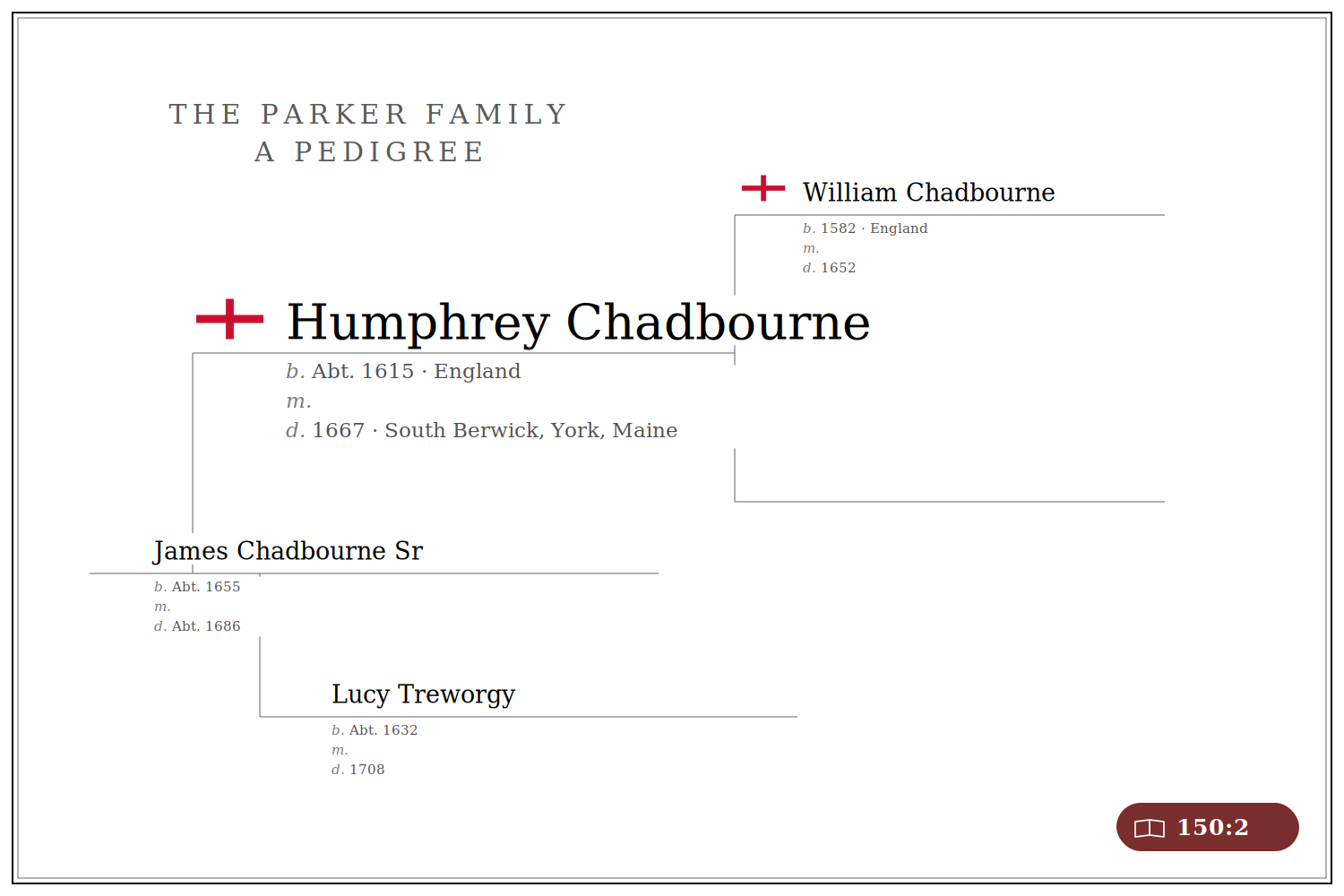
    The history of Portsmouth, New Hampshire, is complicated, and no two accounts agree. But, for a long time, the legend has put my great-nth-grandfather at the center of it.

    Humphrey Chadbourne (1615–1667) — or maybe his father William (1582–1652) — built the first house in Portsmouth, New Hampshire, and everything that’s there now grew up around it.

    The story goes that he came over a housewright, which in 1631 was the top of the carpenter’s trade. They were the men you trusted not just to nail boards together but to raise a frame that would still be standing when your grandchildren were old. Captain John Mason’s Laconia Company had a charter, a stretch of riverbank, and a stand of wild strawberries that gave the place its name. What it didn’t have was a single permanent English building. It needed one, and it needed it to be good, because a real house is how you tell a coastline you’re not leaving. They gave the job to Chadbourne.

    He built the Great House on the slope above the water — a store below, lodging above, the headquarters of the whole venture. Oak frame, mortise and tenon, pinned and joined to stand against everything the North Atlantic could throw up the river, which over the next century was plenty. It held. The men who’d crossed an ocean on a company’s promise now had a roof that meant the promise was real. The settlement had a center. It had a beginning. And the beginning had Chadbourne’s hands on it.

    He didn’t stop at one house. The man who built the first building went on to help build the colony around it. He bought land up the Piscataqua and dealt with the sachems who held it, on terms steady enough that he traded with them for years. He kept the town’s records as clerk. He sat as selectman, then went down to the General Court as a deputy, then took the bench as an associate judge under Massachusetts. He married Lucy Treworgye and raised a houseful of children at Sturgeon Creek. When he died in 1667 he was one of the substantial men of the river — his will written from the Parish of Unity, his estate large enough to take real time to inventory properly.

    That’s the arc the place remembers. A young carpenter raises one stubborn building at the edge of the known world, the building holds long enough for a fishing charter to turn into a town and the town to turn into a city, and the carpenter turns into a founder. The Great House was the seed. Humphrey — or somebody — planted it.

    You can still stand where it stood. Three hundred and ninety years on, the strawberries are gone and the city is not, and the line runs straight back to someone.

    Different people can choose which legends they believe. To be honest, I’m pretty happy believing this one.

    Sources. The attribution of the Great House to Humphrey Chadbourne, as carried by the Strawbery Banke Museum and Wikipedia, traces in popular print to Thomas Bailey Aldrich, An Old Town by the Sea (Boston: Houghton, Mifflin, 1893). Earlier, the conflation of William and Humphrey Chadbourne into a single builder traces to James Sullivan, The History of the District of Maine (Boston: Thomas & Andrews, 1795). The scholarly correction — the family in Tamworth, Staffordshire until the Pied Cow crossing of 1634, with the building contract not surviving — is Robert Charles Anderson, The Great Migration: Immigrants to New England, 1634–1635, vol. II, C–F (Boston: NEHGS, 2001), 33–36.

  • Marching at Liberty: Thomas Stanton (~1615–1677)

    Marching at Liberty: Thomas Stanton (~1615–1677)

    Most of my ancestors are a line on a chart. A lucky few left enough of a paper trail that I can wonder what in the actual #$^%& were they thinking.

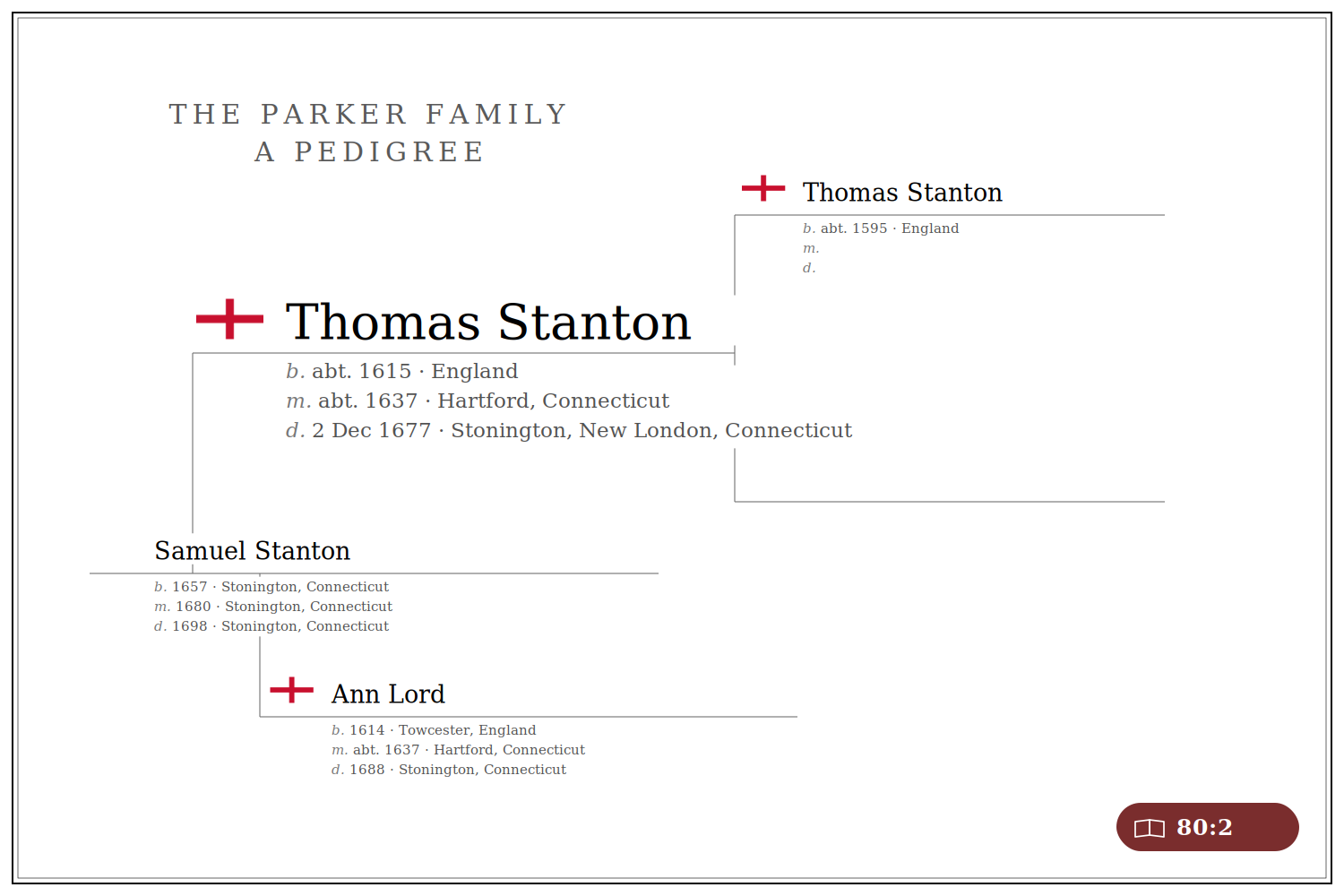
    Thomas Stanton (abt. 1615–1677), my eighth-great-grandfather, sailed from London in 1635 at twenty. Within a year he had taught himself Algonquian — one of the few Englishmen in the colony who could speak to the people whose land the colony was taking. By 1636 he was John Winthrop Jr.’s interpreter.

    The language was his career, and it made him useful to the English who faught what the called the Pequot War.

    Before dawn on 26 May 1637, English forces under Captain John Mason and their Narragansett and Mohegan allies surrounded a fortified Pequot village at Mystic, set it on fire, and shot the people who tried to escape.

    The warriors were mostly away. The village was women, children, and the old. Between four and seven hundred people were burned or killed in about an hour; two Englishmen died.

    The Narragansett and Mohegan who had come with Mason were sickened by it and went home. The English wrote it down as the will of God.

    The next year, the Treaty of Hartford ordered the survivors sold into slavery or handed to the victors, and forbade them to return to their land, to speak their language, or to call themselves Pequot.

    That is the war Thomas Stanton interpreted.

    On a march after Mystic, as the English burned Pequot homes as they went, two Pequot men stood on a hill and shouted at the column. Stanton — “marching at liberty,” moving free of the ranks — asked leave to fire on them. The captain refused.

    Stanton was not a reluctant man dragged along by his usefulness. Given the chance to kill, he asked for it.

    A few weeks later, English forces trapped a large group of Pequot in a swamp near Fairfield. Stanton went in to talk to them. He was trusted, and he spoke their language, and he used both to bring close to two hundred old men, women, and children out of the swamp. They were sold into slavery.

    Connecticut made him its first official interpreter in 1638. The United Colonies put him on retainer for all of New England, and by 1658 he was Interpreter General. He was the English voice at the treaties, the surrenders, and the land transfers across southern New England.

    The conquest needed someone to make its terms understood to the people it was dispossessing. That was his job.

    The record also shows him, later, arguing that the defeated tribes be treated fairly, and protesting the reparations the commissioners kept extracting from them years after the fighting stopped. And it shows Uncas, the Mohegan sachem, coming to Stanton’s house to have him write his will.

    He marched at liberty — no one made him. It was his job, sure, but he chose it, and stayed in it for 40 years.

    Sources. John Mason, A Brief History of the Pequot War — the Mystic fight and the line that gives the post its title, Stanton “marching at liberty.” John Underhill, Newes from America — the allies leaving Mystic. Treaty of Hartford (1638) — the terms imposed on the survivors. The Barbour Collection of Connecticut vital records — the Stonington descent through Anna Stanton. Colony and United Colonies records — Stanton’s interpreter appointments and his post as Interpreter General.

  • In Case She Return: Bethia Payne (~1680–1724) and Dorothy Milbury (fl. 1692–1702)

    In Case She Return: Bethia Payne (~1680–1724) and Dorothy Milbury (fl. 1692–1702)

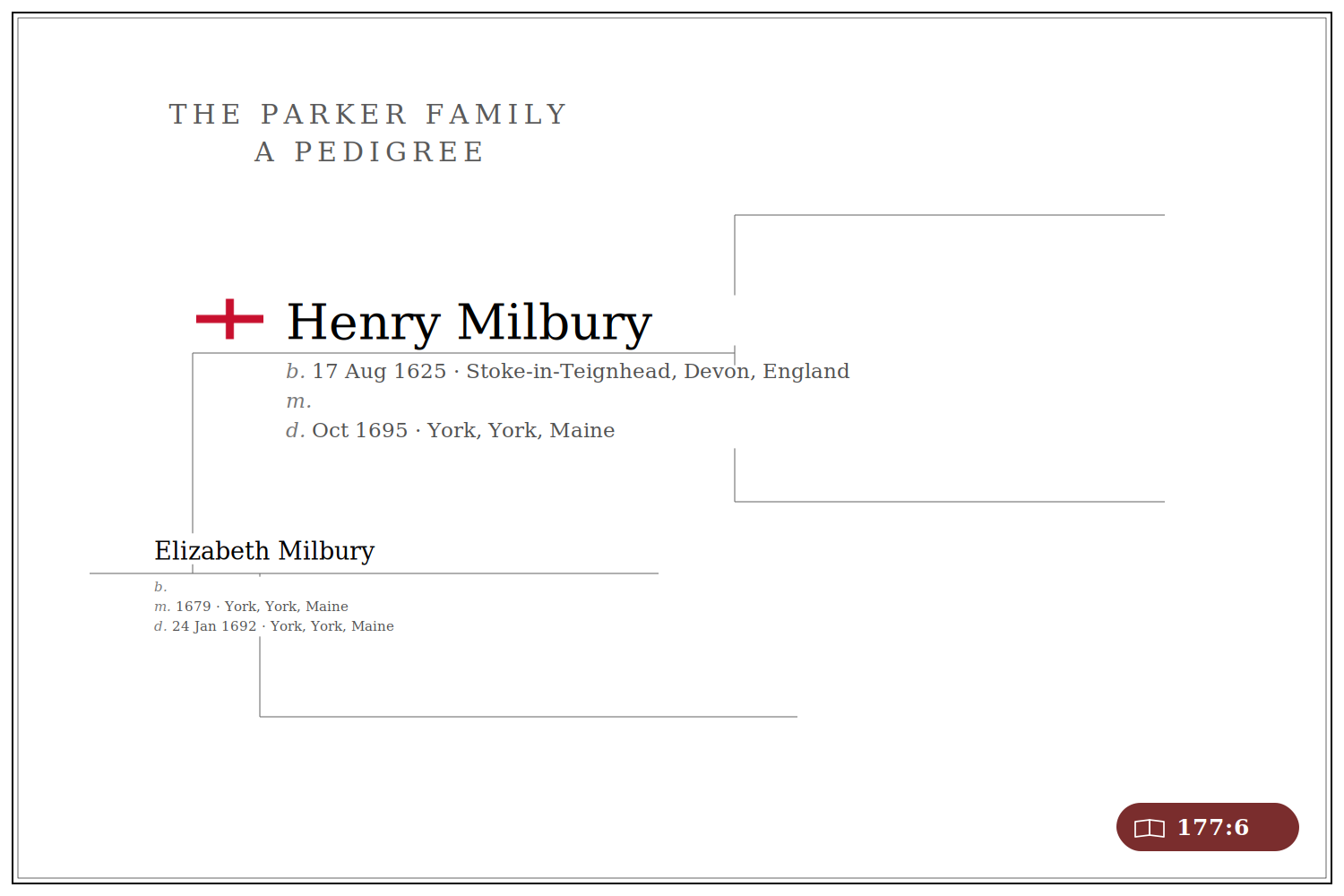
    In June 1695 an old man at York sat down to write his will, and somewhere in the middle of the bequests he had to make a decision most people never have to make.

    Henry Milbury had to decide what to leave a daughter he could not prove was alive.

    Henry was baptized at Stoke-in-Teignhead, in Devon, on 7 August 1625, son of a William Milbury about whom the record knows nothing but the name. He crossed the way half of coastal New England crossed — undramatically, unrecorded. He turned up at York, Maine, and married a daughter of one William Dixon.

    (Dixon is worth ten seconds on his own. He came over in 1630 as a servant to Governor Winthrop, and by 1635 he had jumped his bail. In January 1636/7 he bought a house at York and lived in it for thirty years — cooper, juryman, name on the tax lists, dead in bed with a will.

    Whatever the governor of Massachusetts wanted him for, nobody in Maine appears to have cared. If these people kept diaries about their feelings, they neglected to leave them somewhere I could read them.)

    Then Henry settled into the business of being one of a few thousand people living on the Maine frontier. He farmed on Alcock’s Neck. He took the oath of allegiance in the spring of 1680. He was granted twenty acres in 1691. That is very nearly the complete public record of sixty-six years, and it is the record of a man to whom nothing had happened.

    Then, at dawn on a Sunday in January 1692, that stopped.

    First, the calendar

    The record calls what happened that day the Candlemas Massacre, and the name needs ten seconds too, because it is not English.

    Candlemas is 2 February — the Feast of the Purification, forty days after Christmas, the day the church blesses the year’s candles. York did not keep it. Puritan New England had scrubbed the holy-day calendar down to the Sabbath and a couple of civil fasts, and 24 January 1691/2 was a Sabbath: the minister, Shubael Dummer, preached that morning to a congregation that had no particular feeling about candles.

    The French did keep it. And the French were on the Gregorian calendar, ten days ahead of the Julian one England was still using, so the day York experienced as Sunday 24 January was, to the men coming through the snow, 3 February — Candlemas and a day. The massacre is named for a feast the dead did not observe, on a calendar they did not use. The name arrived later, from the other side.

    Then, the raid

    Somewhere between 150 and 300 Abenaki and Canadians, under the Penobscot sachem Madockawando and the priest Louis-Pierre Thury, came into York through the snow and took the town apart. They burned the undefended houses along the north bank of the York River, which was where the town was. Dummer was killed.

    The dead were counted at about fifty by Banks, who assembled the casualty list; other accounts say a hundred, and the honest answer is that nobody knows. Roughly eighty people were marched north toward Canada, in Maine, in January.

    Henry Milbury lost most of his family between dawn and the end of that day.

    His daughter Elizabeth — killed. Her husband, Thomas Payne — killed. His brother Richard, who had been baptized in the same Devon parish sixty-three years earlier and had followed him to the same town — killed. His daughter Dorothy — taken. His granddaughter Bethia, eleven years old — taken. His grandson Samuel — taken, or so it was reported. His son William was already dead.

    Three and a half years later, nearing the end, he wrote his will. Not one of them had come back.

    The document

    When he came to Dorothy he could not write her down as living and could not write her down as dead, so he wrote her down as both:

    Unto my Deer Daughter now In Captivity with the Indians Dorothy Millbury I will & give the Summ of five pounds, In case she return by gods good Providence from captivity, but if not till then to be paid which Legacy I Intend not payable by my Son at all if she never return.

    A will is a document for settling known quantities. It exists to convert a man into a list. Henry got most of the way through his list and then hit a line item the form does not accommodate, and rather than guess, he wrote a contingency: five pounds, conditional on an outcome no one alive could report, payable never if the condition failed.

    A few lines down, three grandchildren. My two grand children Bethiah Pane & William millbury ten Shillings apeice. William was the son of the son who had died; he was in York, and could be handed the money. Bethia had been in Canada for three and a half years. They are named together anyway. My Grandson Samuell Pain the Sum of ten Shillings sits by itself, on its own line. Whether that means anything, I can’t tell you.

    The will was proved on 1 October 1695. Henry was dead inside four months of writing it, still holding the question.

    What nobody wrote down

    Which leaves seven years, and we do not know one thing that happened in them.

    Neither woman wrote anything down. Dorothy’s entire file is two entries — she appears as a captive on a numbered list of prisoners held in Canada, at page 78, and she is recorded as having returned. Bethia’s is a redemption date. Between the two ends of each there is nothing. No letter, no deposition, no line in a French parish register that anyone has yet turned up.

    What there is instead is a genre, and the genre is the reason we know anything at all about what those years were like for anybody. The captivity narrative: the ordeal, the providential hand of God, the spiritual lesson wrung out of the suffering. Mary Rowlandson published the template in 1682 and it sold like nothing else in the colonies. If you were lucky enough to come back, you gave the world your testimony.

    Neither of these two gave anybody anything. But other people did — from the same war, the same coast, and in some cases the same raiding parties — and while none of it can tell us what happened to Dorothy and Bethia, it tells us what the range was.

    Hannah Swarton was taken at Casco Bay in May 1690, twenty months before York, and walked to Quebec. She was put in Indian dress, one pair of shoes, no stockings, and the arrangement was that she kept their pace or was killed where she stopped.

    Her feet were cut by stones and by ice, and she said that many times she thought she could go no further, and that if they meant to kill her they could kill her. She was on the move from May to February. The York captives walked in January.

    What waited at the other end was not one thing. Swarton was handed along, begged provisions off a French housewife, and was eventually ransomed out of Abenaki hands by the wife of the Intendant of New France — the colony’s chief administrator, second only to the governor.

    She was given French clothes, taken to the hospital, bled and physicked and looked after, and made a servant in the house, and she said the French were as kind to her as she could have expected the English to be.

    She also spent five years under steady pressure to convert, which is the part Cotton Mather cared about when he printed her account in 1697. A good deal of the piety in the printed version is probably his rather than hers.

    John Gyles got both ends of it. Taken at Pemaquid in August 1689, aged nine: six years with the Maliseet, then sold on to a French seigneur on the St John River, then freed in June 1698 — one year before Bethia came home.

    He wrote his own account and published it in 1736, and it refuses to resolve into a thesis. It holds the French household that treated him decently at the end, and it holds his own brother, burned to death for trying to escape.

    And underneath all of it runs the thing the narratives are structurally incapable of showing you, because the people it happened to never came back to write one.

    A woman from Oyster River was taken in 1689 with two daughters, and all three of them stayed. The widow married Edward de Flecheur in Canada in 1710. Her daughter Judith, born 1676, was baptized there as Marie Magdeleine, married Jean le Conte in 1698, and was buried in 1703 — a whole adult life, in French, in the parish books of a country she had been carried into at thirteen.

    Swarton herself got out in 1695; her daughter Mary did not, and was rebaptized Marie Souart that February, and was still on the list of those left behind when her mother’s ship sailed.

    The pattern is age. Adults were ransomed, listed, exchanged and shipped home. Children taken young were absorbed — baptized, renamed, married into a parish — and after enough years there was no particular reason left to go. That was not the system failing. That was the system, and the paperwork is in French because the people ended up French.

    Bethia was eleven going in and eighteen coming out, which is precisely the profile that usually didn’t come out at all. Everything about her file says she should have become somebody’s Marie.

    So here is the entire honest contents of those seven years. Two women walked a few hundred miles in winter with the people who had just killed their family, lived through something in a small colony that had a documented interest in keeping them, and then declined to stay. Whatever was asked of them, they didn’t take it. I’d rather hand you the hole than fill it.

    Afterward

    Bethia was redeemed to Casco Bay in January 1698/9, after seven years, at eighteen — into a province that had burned down around her when she was a child. The war had ended by treaty the previous September, which is probably the mechanism: less bought back than handed back, in the general accounting.

    Dorothy came home too. The date isn’t in anything I’ve got — only that she returned, and that in October 1702 the York court recorded her marriage to John Grant. Which is the sort of ordinary sentence that only reads as a miracle in context. The five pounds became payable.

    And then the paper closes over her again. No death, no burial, no further entry of any kind. She outlived the worst day her town ever had, walked back out of Canada, got married, and the record lost interest in her.

    Samuel never appears again either. No Canadian record, no redemption, no return. The most likely reading of that silence is not a good one.

    Bethia had a testimony to give and a market ready for it. What she left is a conveyance. On 5 December 1711, thirty-one and single, she deeded her dead father’s 1683 land grant to her uncle Richard Milbury, with full warranty. It is the only document of hers we have. (Full warranty, too. She wasn’t leaving her uncle exposed to a title dispute.)

    She married Joseph Preble, born at York in 1691 and eleven years younger than she was — whose grandfather was the immigrant Abraham Preble, who reaches me twice: once here, on my father’s side, and once by a completely separate line down my mother’s to Nana, whose own mother was a Preble. Two arrivals, three hundred years, one man.

    A daughter, Hannah, in 1714. Bethia died at York in May 1724, around forty-four, in the town she had been dragged out of at eleven.

    She could have written the bestseller. The century wanted a testimony out of her and would have paid for one. She gave it a daughter and a deed instead. After what the records had already done to her family, I can see the appeal of being unremarkable on purpose.

    Sources. Genealogical Dictionary of Maine and New Hampshire (Noyes, Libby & Davis) — the Milbury, Payne, Dixon and Preble families, and the Canadian marriages and baptisms of captives who did not return. Henry Milbury’s will, 10 June 1695, proved 1 October 1695, York County probate (Maine Wills, 1640–1760) — the source of the clause the post is named for. Charles Edward Banks, History of York 1:271 — the raid and the casualty list. A Narrative of Hannah Swarton, printed by Cotton Mather in Humiliations Follow’d with Deliverances (Boston, 1697). John Gyles, Memoirs of Odd Adventures, Strange Deliverances, &c. (Boston, 1736). The Irving Preble Genealogy, register no. 19 — Bethia’s marriage to Joseph Preble and their daughter Hannah, 1714. The York County deed of 5 December 1711 by which Bethia conveyed her father’s grant.

  • The Charter and the Pond: Capt. Noah Wiswall (1638–1690)

    The Charter and the Pond: Capt. Noah Wiswall (1638–1690)

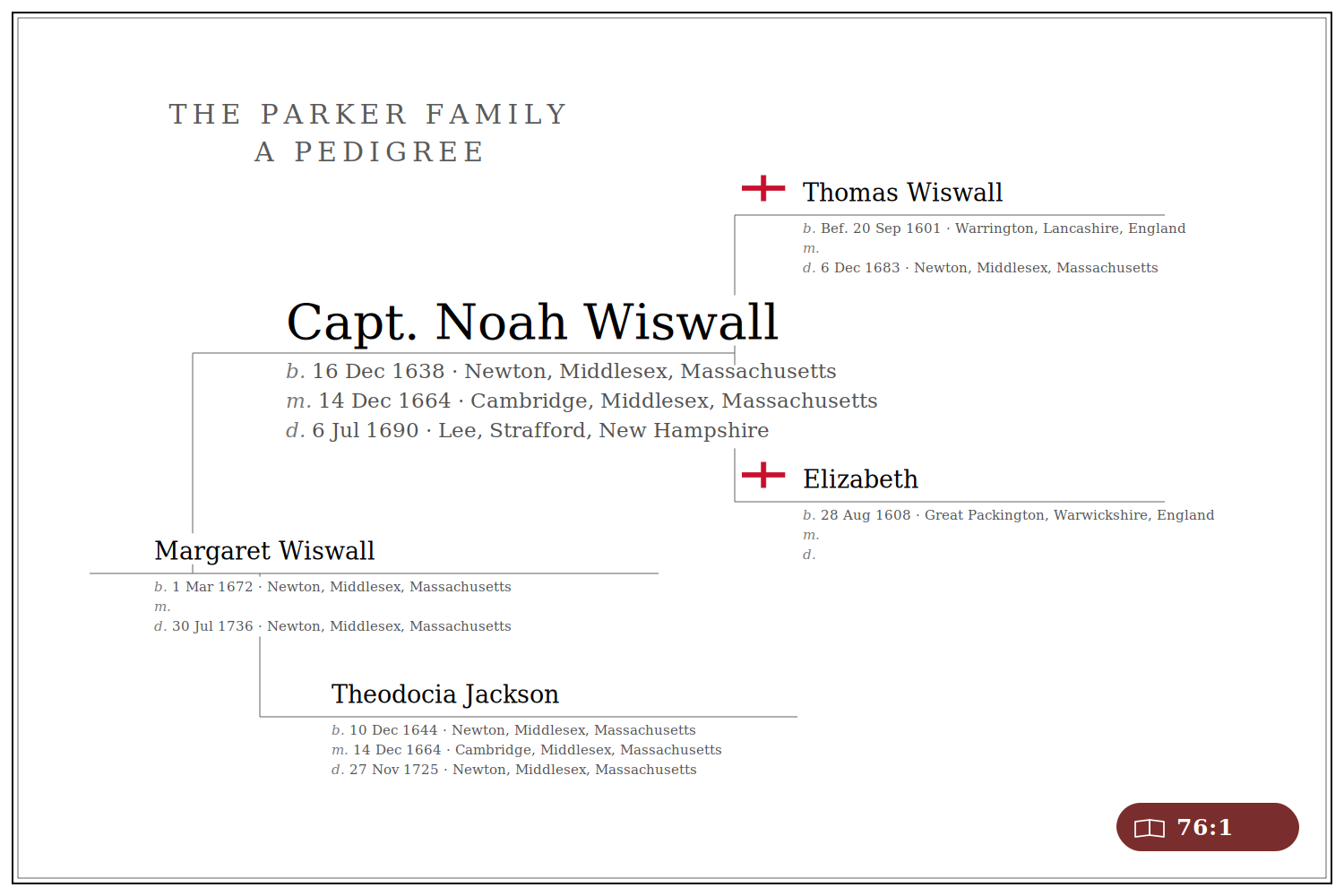
    Capt. Noah Wiswall (1638–1690) was fifty-one years old and had ten children the summer Massachusetts asked him to walk into the woods and go to war one more time.

    He said yes.

    He was a generation past the age when a man is expected to do this, he had a farm in what’s now Newton and a wife and a houseful of kids, and when the colony raised two companies to chase a French and Abenaki raiding party north, Noah took one of them.

    It was King William’s War — the European powers had decided to be at war again, which on the New England frontier meant France arming the Abenaki and the Abenaki fighting to keep the English from spreading any further across their lands.

    On 4 July 1690 a raiding party hit Exeter. Exeter held. The party fell back and made camp on the shore of a pond named for the Rev. John Wheelwright, in what is now Lee, New Hampshire. Those two Massachusetts companies went after them — one under Capt. John Floyd, one under Noah.

    His scouts found the trail at first light on 6 July. The militia came down on the camp and the thing turned into what the old accounts called “a running fight through the woods, after the Indian fashion.” When it was over, three officers and fifteen men were dead — Noah among them, along with his lieutenant Gershom Flagg and his ensign Edward Walker.

    And one of his sons. John Wiswall was about twenty years old and in his father’s company that morning, and he died there too.

    Theodocia Jackson Wiswall, forty-seven years old, buried her husband and her son on the same day, with five children still living and the youngest fourteen. She remarried four years later, the required next step for a woman of that time after doing the arithmetic of how to stay alive.

    The aftermath has its own grim comedy, if you want it. Floyd kept the field for hours after Noah fell, until enough of his men were dead or bleeding that he pulled the rest out — and was promptly second-guessed by people who weren’t there, for not staying longer.

    Capt. James Convers rode out at sunrise the next morning, found seven of the wounded still alive in the woods, carried them to a hospital, then went back to bury everyone else.

    The Charter

    By strange coincidence, while Noah was dying in those woods for Massachusetts Bay, his older brother was in London, losing a different fight to the same colony. The Rev. Ichabod Wiswall was the minister of Duxbury, Ma., down in Plymouth Colony.

    In February of 1690 — months before Noah marched — Plymouth scraped together the money to send Ichabod across the Atlantic to plead for a royal charter. Little Plymouth had never had one, and without it the colony was a legal ghost, eyeballed by its bigger neighbors. Ichabod went to London essentially to keep Plymouth on the map.

    On the other side was Increase Mather — the heaviest minister in New England — who was working the same court for the opposite result: fold Plymouth into Massachusetts Bay and be done with it.

    Two reverends from Dorchester, arguing over a colony’s life in front of the Crown. Mather won. The 1691 charter erased Plymouth and handed it to the Province of Massachusetts Bay — a hostile takeover with a king’s signature on it.

    One Wiswall brother dies in a Massachusetts Bay company defending Massachusetts Bay’s frontier. The other watches Massachusetts Bay swallow the colony he’d crossed an ocean to save. Both Wiswalls lost to the same flag in the same eighteen months.

    The Monument

    Newton put up a monument to its first settlers, and Noah is on it: “Capt. Noah, of the expedition against Canada, killed in battle with the French and Indians, 1690. Leaving a son Thomas.”

    Not to be salty, but Noah’s daughter Margaret is the reason I’m here. She married a Parker and carried the line out of that grief and down to me.

    He went into the woods at fifty-one and didn’t come back, and somewhere in the wreckage of that summer is a girl who would grow up and marry, ensuring her father was somebody’s ancestor instead of only a name carved on the south side of that monument.

    Yet the monument speaks of the son but fails to mention the daughter.

    Sources. The Wiswall Genealogy — descent and the Newton, Massachusetts marriage to Theodocia Jackson, 1664. WikiTree (Wiswall) and the Newton Vital Records — Noah’s children, including John, killed beside him, and the eldest son Thomas, named on the First Settlers Monument. Contemporary accounts of the Wheelwright’s Pond fight, 6 July 1690, and of Ichabod Wiswall’s charter agency in London.