Robert Parker was one of the finest scholars England produced in his century, and the king wanted him in chains.
He attended Magdalen College, Oxford. He was a theologian good enough that Cotton Mather, two generations and an ocean later, called him the father of every Nonconformist in England.
In 1607 he wrote a treatise that caused James I to put a bounty on his head. There’s even a whisper of royal blood — through his wife, a claimed granddaughter of a knight and a Lady Spencer (yes, the Spencer).
He had a son who was a prominent civic leader in his own right, founding a town at the mouth of the Merrimack in Massachusetts named Newbury. There’s a river named for him too. And a grandson named Joseph, who settled in Andover and lived so long that he used his will to complain about his “great age.”
This. This is the line you want at the end of your genealogical treasure hunt. A great line — a figure the right people have heard of, a person who isn’t responsible for any known genocide(s), a hint of royal blood, a town, a river. A line that leads inextricably to Samuel Parker.
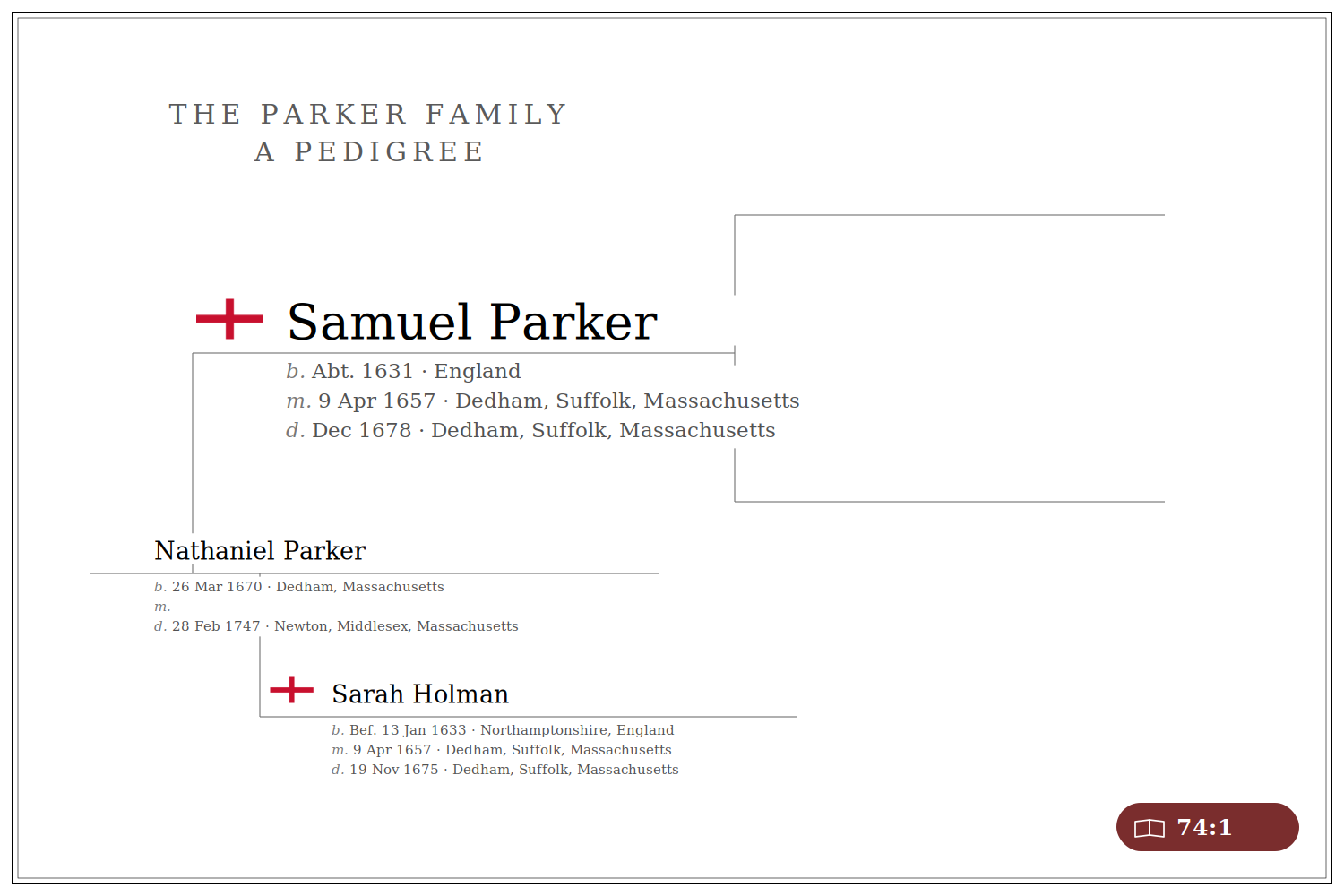
And Samuel Parker is my immigrant ancestor on the line of my father, the line that bears my own last name.
It’s just … well … a different Samuel Parker.
Joseph’s Samuel and my Samuel have the same death year, which looks promising at first. But fake Samuel was born in Andover in 1659. By that year, my Samuel had been married to Sarah Holman for two years, and was starting to think about making me some grandfathers.
Looking through Ancestry.com it seems like there are 1.2 billion Samuel Parkers, which makes sense when you start to tease apart the name itself.
Parker is a job. It comes into English with the Normans, from parquier — the keeper of a park. He walked the pale, the great banked fence around a lord’s hunting ground. He kept the deer in and the poachers out.
It was a gentleman’s post, which is precisely how a handful of Parker families climbed far enough to collect the sixty coats of arms and the Earls of Morley that the surname websites can’t stop waving around.
By 1300, England held more than three thousand deer parks — roughly two percent of the entire country fenced off for deer. Every one needed a keeper. Three thousand parks, three thousand-odd men called “the parker” by their neighbors, in every county with a fence and a herd, and not one of them was related to the next.
An occupational surname has no ancestor. It has a trade. That’s why Parker was the forty-seventh most common surname in America the last time anyone bothered counting.
It’s not like “Roosevelt” where you hear it once, and then you just know that everybody with that last name is related. When I punch “Samuel Parker, England” into the search bar, I’m not looking at one record in one church. I’m standing in front of a name that was struck — separately, simultaneously — in every corner of England.
I’ve reached a wall. And my wall isn’t a birth certificate lost in a fire in the 1800s. My wall is the name itself.
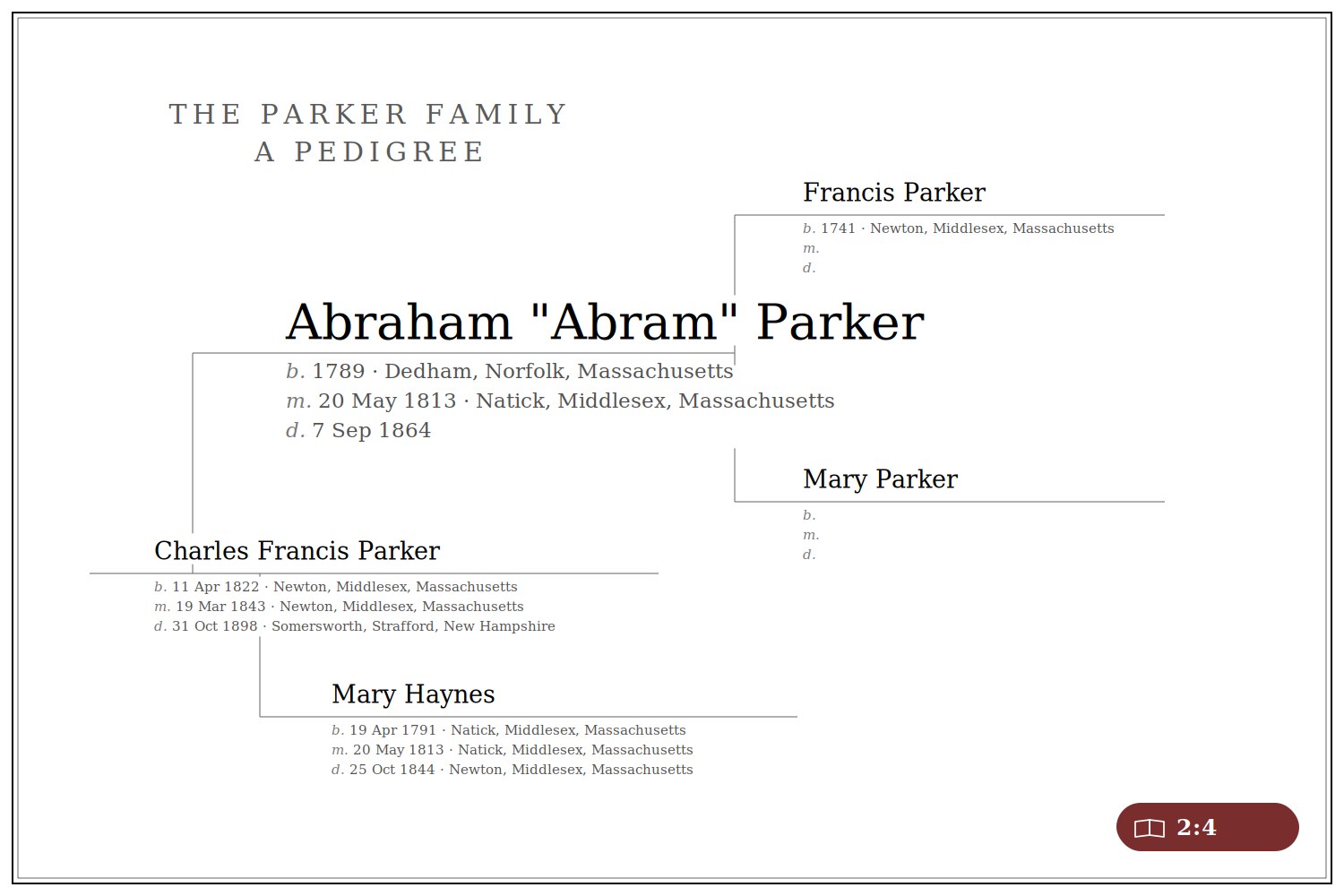
Two different Parker genealogists, one in 1911 and one in 1913, traced my family line back as far as they could go, and both wrote the same word and stopped: England.
And that’s all I’m going to get.
A name would sure help satisfy my completion fetish, but “father unknown” is what actually happens in real life.
I’ll take the blank.
So I’m done with the Parker surname, at least for now. I can turn my attention to the rest of my Parker family. The MacDonalds are next, then maybe the Tituses — or the Titusi? Followed later by the Pikes. And finally the-Haskells-and-the-Prebles, the family that taught me the definition of the phrase “pedigree collapse” when they intermarried so often that I lost a clear understanding of which family is which.
If this is the end for the Parkers, that isn’t a failure of the work. It’s the edge of it.
Samuel’s namesakes spent four centuries guarding the boundary — keeping what was inside the fence in, and everyone else out. The name still gets handed down. There are Parkers being born this year. And at the far end, it stops at a man whose own father was the literal boundary between the real and what we want the world to be.
Beyond the pale, and no way through.
Sources. Samuel Parker’s marriage to Sarah Holman (Dedham, 9 Apr 1657) and the birth of son Nathaniel (1670) from the Dedham Vital Records; his English origin without parentage from John W. Linzee, The History of Peter Parker and Sarah Ruggles (1913), and Augustus G. Parker, Parker in America 1630–1910 (1911), both of which carry the line only as far as “England.” Joseph Parker of Andover (tanner, d. 1678) and his son Samuel (b. 14 Oct 1659) from the Vital Records of Andover and Joseph’s will, Essex County Probate (dated 4 Nov 1678, proved 26 Nov 1678 at Salem). Rev. Robert Parker (c. 1564–1614) and his son Rev. Thomas Parker of Newbury (1595–1677, d. unmarried) from the Dictionary of National Biography and Robert Charles Anderson, The Great Migration. The deer-park count from Oliver Rackham, The History of the Countryside (1986); the surname’s occupational origin from Reaney and Wilson, A Dictionary of English Surnames.
Podcast: Play in new window | Download