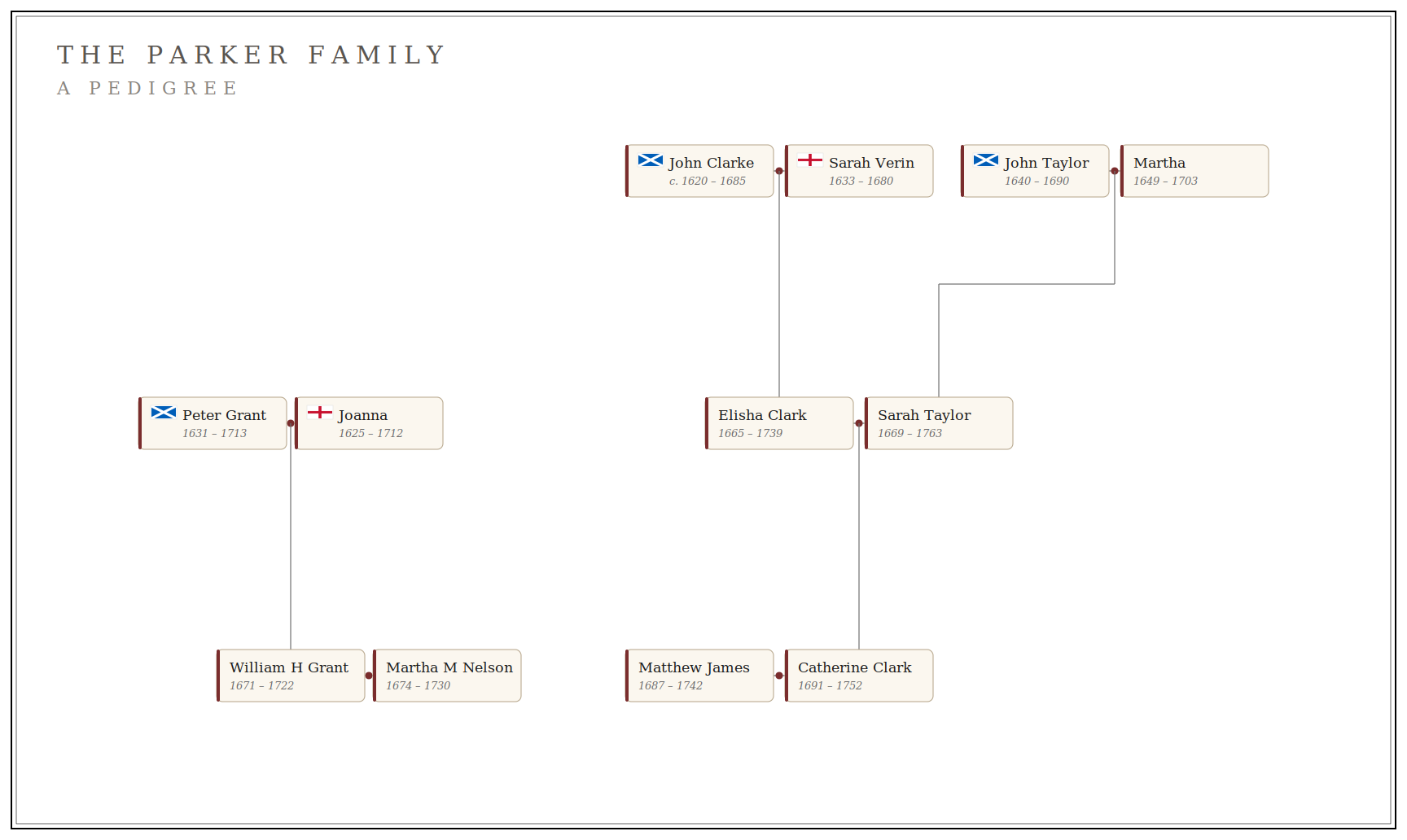
Three of my great-nth-grandfathers — Peter Grant, John Clark, and John Taylor — crossed the Atlantic on the same ship, and not one of them chose to be on it.
The ship was the Unity. It sailed from London in November of 1650 carrying a hundred and fifty Scottish prisoners of war, each under a seven-year sentence of labor, sold by the pound to a failing iron works outside Boston.
To explain the prisoners, I should explain the war.
Oliver Cromwell was a Puritan general who fought and won the English Civil War, beheading King Charles I in 1649, and abolishing the monarchy. His revolution made England a republic, with him at its head. He is the patron saint of “we killed the tyrant and managed to replace them with something worse.”
When the dead king’s son inconveniently turned up in Scotland, the Scots raised him an army — out of a desire to both systematically piss off England and plant a Stuart on the throne who’d turn Scotland Presbyterian.
Cromwell, never being much for competition, marched north to end the threat before it could come south. He found Charles II’s army at Dunbar, but managed to get himself pinned against the sea, with his army sick and starving, and a larger Scottish force on the high ground above.
Then the Kirk’s ministers — who’d already purged the army of every officer they judged insufficiently godly — decided something like, “we need pious men more than competent ones,” and “who needs the high ground?”, and marched the Scots down off the hill, over General Leslie’s objections, to be routed by Cromwell’s veterans inside of an hour.
Trust the Scots to snatch defeat from the jaws of victory.
A few thousand Scots were taken prisoner and marched south — roughly a hundred miles, on foot, with no food. The jailer’s own letters record it: men who fell behind were shot, and the starving prisoners penned overnight in a walled garden dug up raw cabbages and ate them whole, mud and roots, which only killed them faster.
They were held in Durham Cathedral, where dysentery and cold took some seventeen hundred more.
(If that number feels abstract, it stopped being abstract in 2013, when a construction crew digging behind Durham Cathedral for a new café cut straight into a mass grave. The bones were the Dunbar prisoners — tipped in without ceremony, exactly where they’d died. It took until 2018 to rebury them properly.)
The prisoners of war were, to the Cromwell regime, an asset that shouldn’t be wasted by slowly killing them in jail, and found themselves a London proto-capitalist named John Becx who owned a failing iron works at Saugus, north of Boston, that needed cheap hands.
Becx bought himself a crop of unwilling Scottish prisoners, a hundred and fifty of the soundest, who were selected on the explicit standard of being “well and sound and free of wound.”
He loaded them into the hold of the Unity and shipped across the winter Atlantic. Roughly one in ten died on the crossing. When the hold finally opened for good, three of my great-granddads climbed out of it.
Peter Grant (1631–1713)
Peter Grant was nineteen at Dunbar. He went first to the iron works at Saugus. It failed more or less continuously (it’s now a national historic site, which is what we do with businesses that lose money for a living) and he was sent north to the sawmills on the Piscataqua.
He served out his time and then bought fifty acres of his own. The deed survives, and it names him “Peter Grant, Scotsman,” which in colonial Maine was half identification and half raised eyebrow. He’d come over with his brother James, also a prisoner on the Unity; and when James died, Peter married his widow, Joan, and kept the family on its land.
John Taylor (1640–1690)
John Taylor came off the Unity in the group sent up to the Great Works sawmill in what’s now South Berwick — about twenty-five Scots set to cutting the giant white pines the British navy wanted for masts. He served his indenture, took his fifty acres, and then the former prisoner — a man shipped here in irons by an English court — got himself appointed constable. And grand juror.
But, he was not particularly solemn about it. In 1669, the York County Court formally admonished Taylor, along with a knot of his fellow Scots, for saying “the divell” too freely in everyday talk. You survive Dunbar, the march, the cathedral, the ocean, and seven years of bondage, and the colony’s official grievance against you is that you curse too much. His 1687 will left thirty acres to each of his five daughters, so he died with a good deal more land than he started with.
John Clark (1620–1685)
John Clark’s thread runs through his wife, and she gets the best entrance of the three anyway.
In 1652 the Essex County court fined a young woman named Sarah Verin for the crime of wearing a silk hood. This was an actual offense: Massachusetts kept sumptuary laws reserving fine dress for the right rank of people, and someone had looked at the stepdaughter of an iron-works carpenter, decided she was dressing above her station, and reported her.
Sarah, fined for the hood, married a Dunbar Scot bonded at the very iron works where her stepfather worked. Whether she meant anything by it, the record doesn’t say.
Scots’ Charitable Society
Then the part that warms my cold, jaded, progressive heart:
In January of 1657, in Boston, twenty-eight Scotsmen signed a short plain agreement to keep a common box of money “for the releefe of our selves being Scottishmen or for any of the Scottish nation whome we may see cause to helpe.” Their indentures were just then running out — newly free, and immediately organizing to feed and bury one another, because nobody else would.
That box is now the Scots’ Charitable Society, the oldest charitable organization in the Western Hemisphere. Three hundred and sixty-nine years later it still meets, and still gives money away.
On the founding roster of twenty-eight names are Peter Grant, his brother James, and a John Clark, whom I’ve drawn the obvious conclusion is none other than my own great-nth-grandfather.
I love the poetry of it. Men who had been sold off a dock a few years earlier put their names to the oldest charity on the continent.
And one more line in the records closes the circle. Taylor’s daughter Sarah married Clark’s son Elisha. Two of these prisoners — off the same ship, scattered to different mills on the same river — became grandparents to the same children.
It can’t have been an accident. The Scots that Cromwell flung across an ocean found each other on the Piscataqua and did the most durable thing a scattered people can do: they married their children to one another, deliberately, until “the Dunbar men” stopped being a cargo manifest and turned into a town.
There are places on that coast — a Berwick, a Scotland parish in York — that exist because the plan to disappear these men failed.
They were shipped over as the end of something — a defeated army, sold and scattered and entered in the books as property and labor and “Scotchmen.”
Within seven years they had a charity. Within a generation, a neighborhood. Within ten generations, me — putting their names back into the world one generation at a time.
Which is the one thing the people who loaded the Unity were trying to make sure they would never ever do.
Sources. The Battle of Dunbar (3 September 1650), the forced march to Durham, and the 2013–2018 Durham Cathedral mass-grave excavation and reburial. The ship Unity — sailed November 1650 with ~150 prisoners consigned by John Becx to the Saugus Iron Works, selected as “well and sound and free of wound,” and the distribution of its men to Saugus and the Maine sawmills — from Saugus Iron Works records and the Scottish Prisoners of War Society. The Scots’ Charitable Society founding agreement of 6 January 1657 and its roster of twenty-eight names. York County, Maine deeds and probate — the “Peter Grant, Scotsman” deed, Grant’s marriage to Joan, Taylor’s constableship, the 1669 admonishment, and his 1687 will. Essex County, Massachusetts Quarterly Court records — the 1652 fine of Sarah Verin. Stackpole’s Old Kittery and the Genealogical Dictionary of Maine and New Hampshire for the Grant, Taylor, and Clark families.