The history of Portsmouth, New Hampshire, is complicated, and no two accounts agree. But, for a long time, the legend has put my great-nth-grandfather at the center of it.
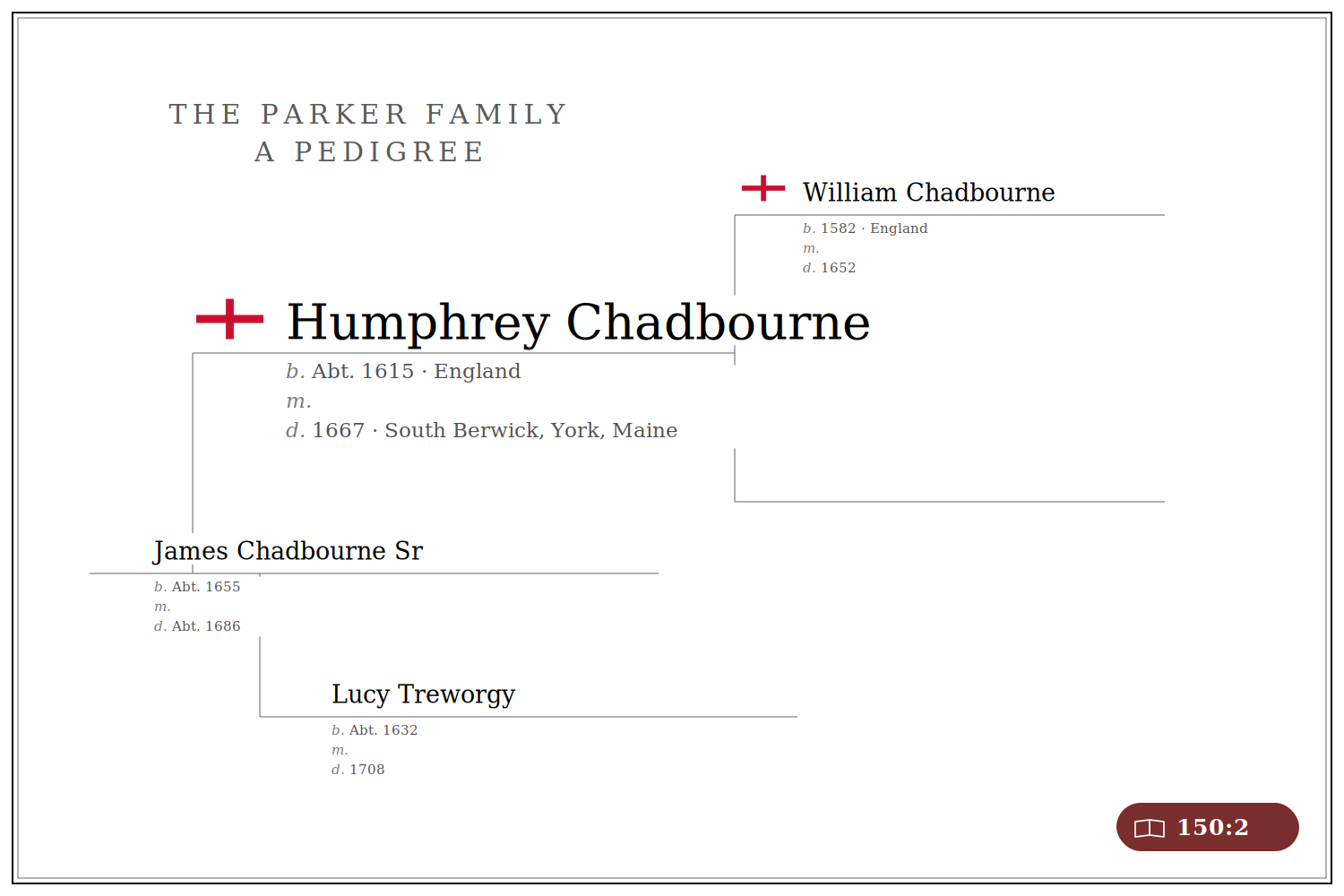
Humphrey Chadbourne (1615–1667) — or maybe his father William (1582–1652) — built the first house in Portsmouth, New Hampshire, and everything that’s there now grew up around it.
The story goes that he came over a housewright, which in 1631 was the top of the carpenter’s trade. They were the men you trusted not just to nail boards together but to raise a frame that would still be standing when your grandchildren were old. Captain John Mason’s Laconia Company had a charter, a stretch of riverbank, and a stand of wild strawberries that gave the place its name. What it didn’t have was a single permanent English building. It needed one, and it needed it to be good, because a real house is how you tell a coastline you’re not leaving. They gave the job to Chadbourne.
He built the Great House on the slope above the water — a store below, lodging above, the headquarters of the whole venture. Oak frame, mortise and tenon, pinned and joined to stand against everything the North Atlantic could throw up the river, which over the next century was plenty. It held. The men who’d crossed an ocean on a company’s promise now had a roof that meant the promise was real. The settlement had a center. It had a beginning. And the beginning had Chadbourne’s hands on it.
He didn’t stop at one house. The man who built the first building went on to help build the colony around it. He bought land up the Piscataqua and dealt with the sachems who held it, on terms steady enough that he traded with them for years. He kept the town’s records as clerk. He sat as selectman, then went down to the General Court as a deputy, then took the bench as an associate judge under Massachusetts. He married Lucy Treworgye and raised a houseful of children at Sturgeon Creek. When he died in 1667 he was one of the substantial men of the river — his will written from the Parish of Unity, his estate large enough to take real time to inventory properly.
That’s the arc the place remembers. A young carpenter raises one stubborn building at the edge of the known world, the building holds long enough for a fishing charter to turn into a town and the town to turn into a city, and the carpenter turns into a founder. The Great House was the seed. Humphrey — or somebody — planted it.
You can still stand where it stood. Three hundred and ninety years on, the strawberries are gone and the city is not, and the line runs straight back to someone.
Different people can choose which legends they believe. To be honest, I’m pretty happy believing this one.
Sources. The attribution of the Great House to Humphrey Chadbourne, as carried by the Strawbery Banke Museum and Wikipedia, traces in popular print to Thomas Bailey Aldrich, An Old Town by the Sea (Boston: Houghton, Mifflin, 1893). Earlier, the conflation of William and Humphrey Chadbourne into a single builder traces to James Sullivan, The History of the District of Maine (Boston: Thomas & Andrews, 1795). The scholarly correction — the family in Tamworth, Staffordshire until the Pied Cow crossing of 1634, with the building contract not surviving — is Robert Charles Anderson, The Great Migration: Immigrants to New England, 1634–1635, vol. II, C–F (Boston: NEHGS, 2001), 33–36.
Podcast: Play in new window | Download