In 1837 Governor Robert Dunlap of Maine announced that a foreign power had invaded. He wasn’t wrong, per se, but to be clear, he was talking about Canada.
What followed was a genuine international incident between the United States and the great white north, and it produced exactly one agreed-upon casualty — a man who, depending on which account you believe, drowned, froze to death, was run over by an army supply wagon, or was trampled to death feeding horses.
We’ll get to him later.
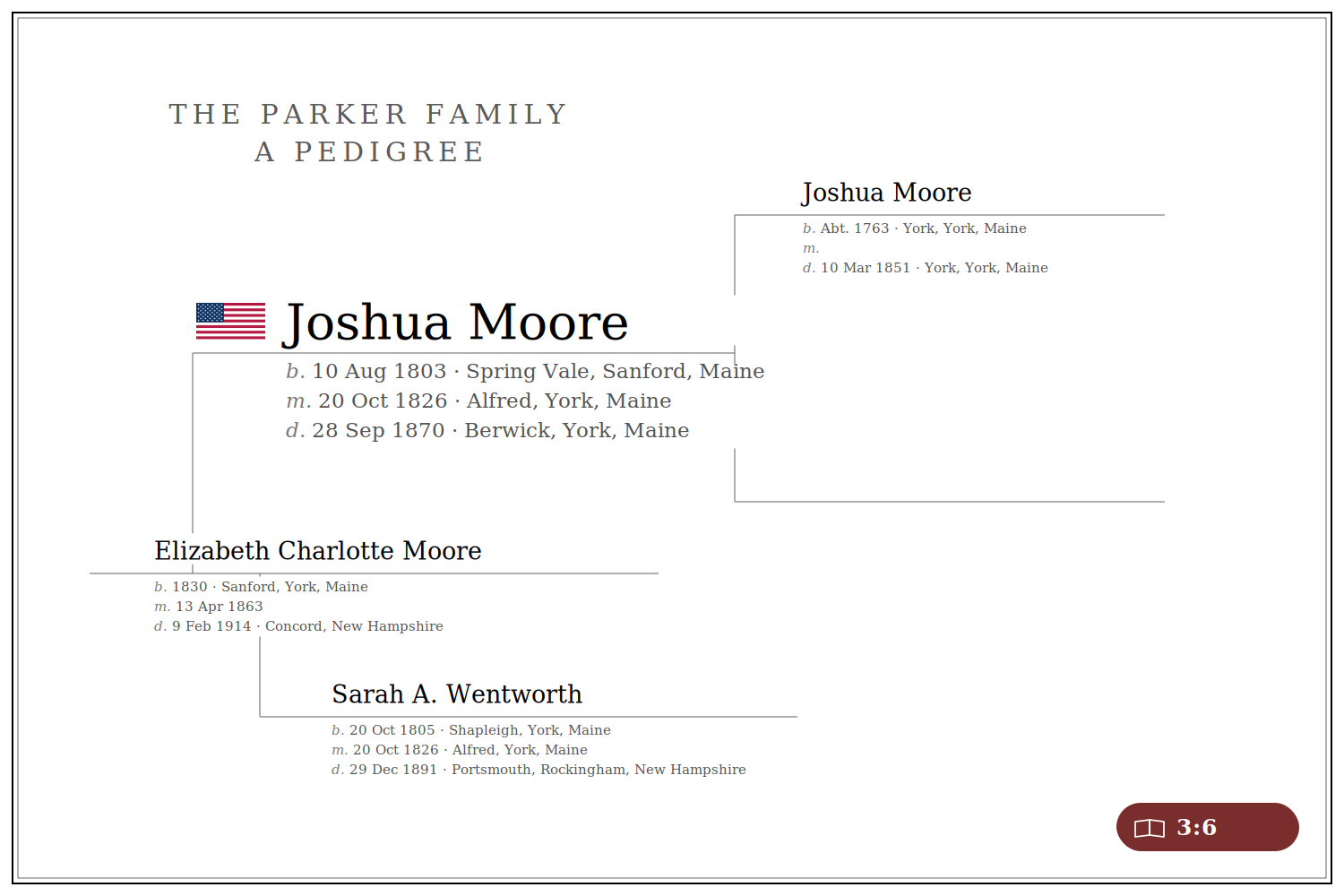
First, the war. My great-great-great-grandfather Joshua Moore (1804–1870) — up the Parker side, through the McCrillises — was thirty-five and living in Sanford, Maine, which made him precisely the kind of man who was “supposed” to be fighting this whole thing.
The fight itself was over a line on a badly drawn map. The 1783 Treaty of Paris had drawn the border between Maine and New Brunswick in language so vague that fifty-odd years later nobody could say where it ran — which would not have mattered, except the disputed strip turned out to hold the best timber in the northeast.
Crews from both sides were cutting it, much to the chagrin of the other side. Maine got so grumpy that it sent its land agent, Rufus McIntire, up the Aroostook with a posse to arrest the Canadian lumbermen. The Canadians arrested him instead and hauled him to Woodstock in chains, for what the lieutenant-governor of New Brunswick, with magnificent restraint, called “an interview.”
Maine lost its damn mind.
The legislature appropriated $800,000 and called out the militia. Nova Scotia voted $100,000 to help defend New Brunswick. And the U.S. Congress, not wanting to be left out, authorized $10 million and fifty thousand men to go fight over pine trees. Soon, reports came in that British soldiers were sailing up from the West Indies to join the party.
To commemorate this absurdity, a fighting song was composed in Bangor and set, for reasons known only to Bangor, to the tune of “Auld Lang Syne.” (“We are marching on to Madawask, / To fight the trespassers.”) And, yes, actual militia companies marched north actually singing it.
And then … nothing happened. Everyone had mobilized, everyone had dug in, but the fighting politely declined to occur.
At the time, great-great-great-grandfather Joshua Moore was a member of the Maine Militia for York County’s 1st Division, so he was sitting at home watching TV waiting for his call-up to battle.
President Van Buren, perhaps to boost his favorability numbers or push some sordid affair with a White House intern out of the 24-hour news cycle, sent General Winfield Scott north to keep the peace. Scott arranged a truce with the New Brunswick side by the end of March, and the whole pending apocalypse evaporated.
Mainers named it the Pork and Beans War, after the rations. And some say the ghost of Granddad Moore is still watching Fox News to this day waiting for his big call-up to “the show.”
Private Hiram T. Smith, American Hero
Now. About that casualty.
Roughly thirty-eight men did die during the Pork and Beans War — none in combat, all from disease, exposure, or accident, most of them while cutting a military road through the north Maine woods in a winter that hit forty below.
But the one everybody remembers is Private Hiram T. Smith of Haynesville, who holds the distinction of being the only agreed-upon casualty of a war nobody fought, and the further distinction of having died in about six mutually exclusive ways.
In 1930 the Daughters of the American Revolution put a marker on his grave — a generous gesture toward a man whose war had nothing whatsoever to do with the American Revolution. The marker it had replaced lauded him as a casualty of the “Indian Wars, 1828,” a conflict and a year to which he had no connection.
The rival candidate for sole casualty, depending on who you ask, is a cow shot by mistake during the victory celebration at Fort Fairfield. Or a pig that wandered across the border at the wrong moment. The records, with admirable consistency, do not say.
So that’s the war Joshua sat out: a ten-million-dollar mobilization whose lasting monuments are a fort that never fired a shot, a fighting song set to a tune none of us know the words to, and a grave in Haynesville that can’t get the man, the war, or the decade right.
Postscript: Joshua’s Son-in-Law’s Brush with Glory
A real war did find this family. It came a generation late, but even then the Parker Family still missed out on the action.
Joshua’s daughter Elizabeth married a man named Elihu McCrillis, and in September 1861 — five months into the Civil War — Elihu enlisted as a musician. He mustered into the band of the 9th Maine Infantry, which promptly sailed to South Carolina, and settled into garrison duty on the Sea Islands and later at Fernandina, Florida.
But Elihu was gone before anything got too exciting, because in the summer of 1862, Congress looked at the books and decided the army’s regimental bands were a luxury it could no longer afford. Public Law 165 abolished them outright, and every band in the volunteer service was mustered out.
Elihu was discharged on 1 November 1862, having spent the deadliest war in American history playing music on the Carolina coast until the government laid off the band.
That’s the Moore men and their wars. Joshua drew the one with the pig for a casualty and wasn’t even called up. His son-in-law drew the one with the six hundred thousand dead and spent it in a brass section that got cut for cost.
But the best news is that both of them came home and made little grandfathers and grandmothers for me. Though to be honest, I assume that’s only because their wives didn’t give them the option to sit it out.
Sources. The Wentworth Genealogy (1878), vol. 2, p. 189, no. 2140 — descent. Maine militia muster rolls, 1838–39 — the record of who was called up for the Aroostook standoff, and the absence of Joshua’s York County division from it.
Podcast: Play in new window | Download