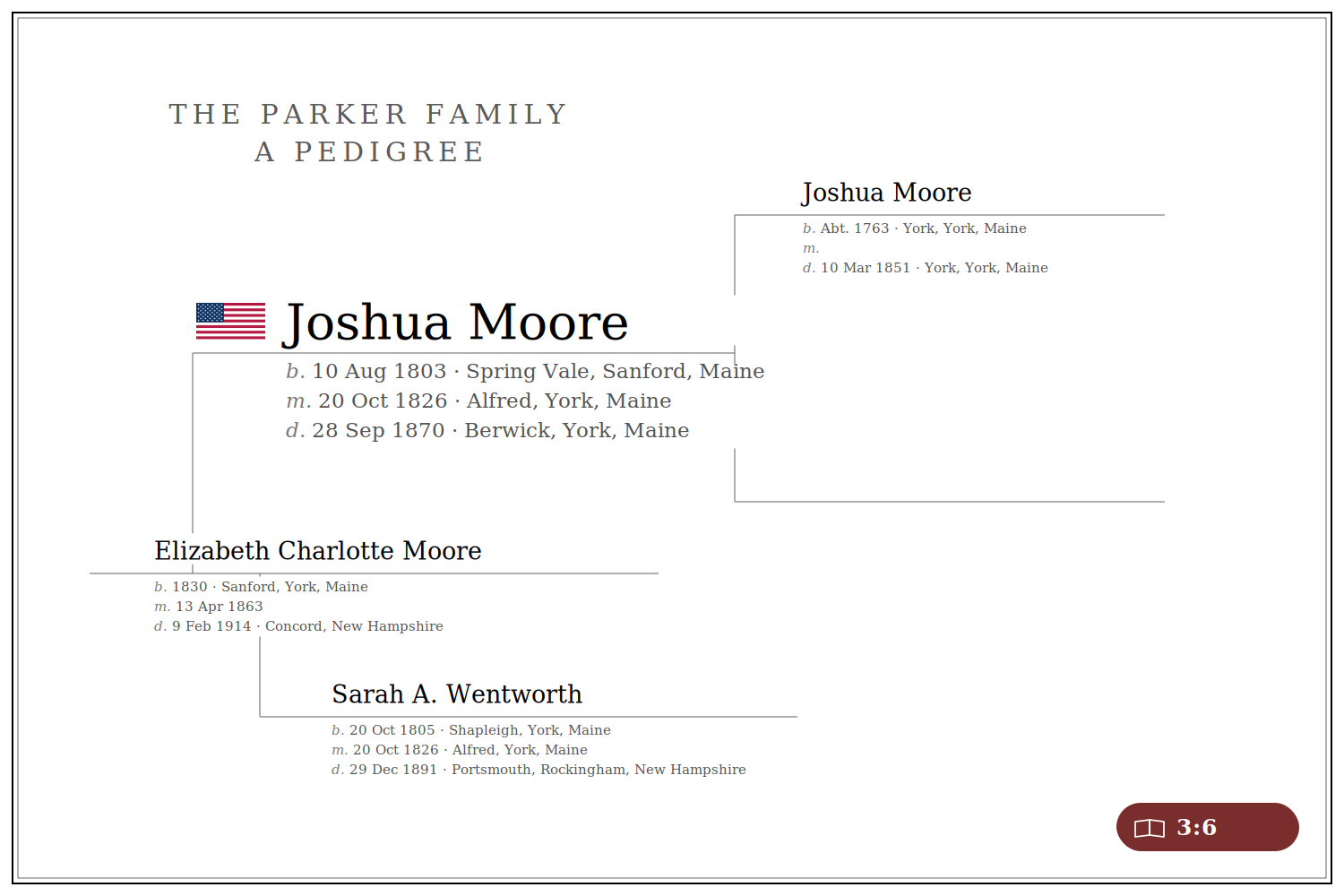
Abraham Parker was the first ancestor who ever told me to go to hell.
Well, not in so many words — when he died 160-odd years ago, what he left me was a handful of records that named everyone in his life except his parents. That was the problem. Not that the trail ended. That I couldn’t see where it went.
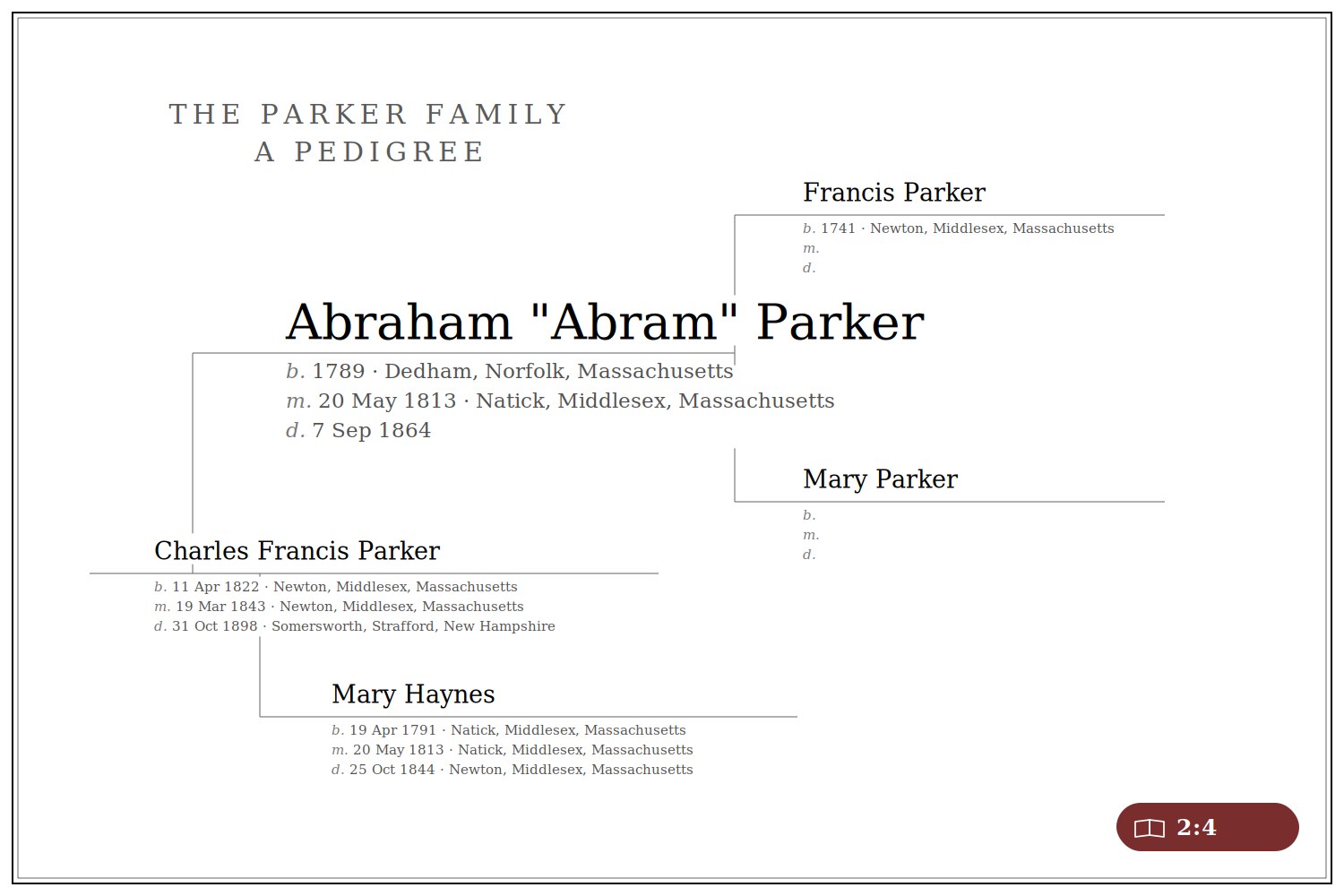
Getting to him was easy. He’s my great-great-great-grandfather, and every link from me to him is a Parker: my father, his father, his father, his father, then Abraham (1788–1864). Married Mary Haynes in Natick in 1813.
And then the trail just stopped.
It stung in a way I didn’t expect, because Abraham was a Parker. My Parker. By blood he’s no more or less family than a Titus or a Pike or a McCrillis — same fraction of me, same distance back.
But Parker’s the name on my driver’s license, and my mailbox, and yet here was Abram — he signed it both ways — cruelly slamming the genealogical door in my face.
It wrecked me a little. It also kept me up for weeks. So I did what every beginner does when a wall won’t move.
I forced it.
Here’s how you force it. You pattern-match on names — and the colonial records are lousy with the same dozen first names, doubly true if the names are biblical. You “eliminate” the people who can’t be related to you, and whatever is left is your family.
When I did this, Abraham’s father was Elijah Parker of Freetown, and his grandfather was Capt. Elisha Parker of Scituate. And then, a couple generations back, my tree hit a vein of pure gold:
- A Mayflower passenger. Henry Samson, who sailed on the Mayflower itself in 1620 at about sixteen years old. He survived the brutal first winter, living another 64 years and having nine children.
- A man who helped hang an innocent woman. Henry Kinne Jr. — one of the people who gave testimony against Rebecca Nurse during the Salem witch trials. Nurse was about as sympathetic (and demonstrably innocent) a victim as the panic produced: elderly, devout, a respected member of her church.
- One of the creepy girls who did the accusing. Priscilla Lewis Kinne had a sister, Mercy Lewis, who was one of the “afflicted girls” at the center of it all. Orphaned when her family was killed in a raid on the Maine coast, by 1692 she was one of the most active accusers in Salem, her testimony helping convict more than a dozen people.
- A Hilton. Hannah Hilton, a few branches up the same invented line, and the reason I spent an afternoon reading about a family that turned out not to be mine.
- A cousin of Longfellow. Henry Wadsworth Longfellow was suddenly my somethingth-cousin-something-times removed. Longfellow even wrote a famous poem, The Courtship of Miles Standish, romanticizing this exact generation of Pilgrims.
These were my people, I just knew it. Even the crazy ones … they were totally my type of crazy. I was so sure.
About a week later it caught up with me. I had known all along, in the part of my brain I’d stopped listening to, that I hadn’t eliminated all the possibilities — I just wanted so badly for it to be done and true that I just … stopped looking. This “strategy” of genealogy has a shelf life. It lasts right up until the moment the Judeo-Catholic guilt sets in, and you feel compelled to start looking again.
It turns out that the real answer was quieter than the fantasy. After another two weeks of banging my forehead on the desk, it turned out that Abraham’s father was Francis Parker of Newton — son of Enoch Parker, a Harvard schoolmaster.
Behind Francis? No Mayflower, no witches, no poets. Just a documented line of boring-but-safe Parkers whose only excitement seemed to be moving from Newton to Dedham and back every two or three generations.
It isn’t a bolt of satisfaction lightning when the answer arrives without a single dramatic document to close the case in one stroke — but I’m learning that type of Indiana Jones #$@# doesn’t happen.
But my flirtation with the other Abraham did cost me. I had fallen in love with my false Parker family tree.
I loved my very own first Mayflower hit. I loved that I was related to a Hilton (Hannah, not Paris). I even loved that I was related to the creepy girl in Salem who lied about witches.
So Abraham told me to go to hell. Turns out he didn’t care that I wanted him in my tree so badly that I made him dress up as someone else.
It’s awkwardly fitting that the ancestor who taught me to wait for the truth instead of inventing it was the one whose name I’d been carrying the whole time.
Hopefully, because I’ve now learned it first on my own name, it’ll stop me from screwing up anybody else’s.
Sources. The 7 September 1845 Roxbury, Massachusetts marriage record — Abraham entered as “widr., a. 56 y., mason, s. Francis and Mary,” the document that names his parents. Newton, Massachusetts vital records — the single Francis Parker of that generation, son of Enoch, married to a Mary. Natick, Massachusetts vital records — Abraham’s 1813 marriage to Mary Haynes.
Podcast: Play in new window | Download