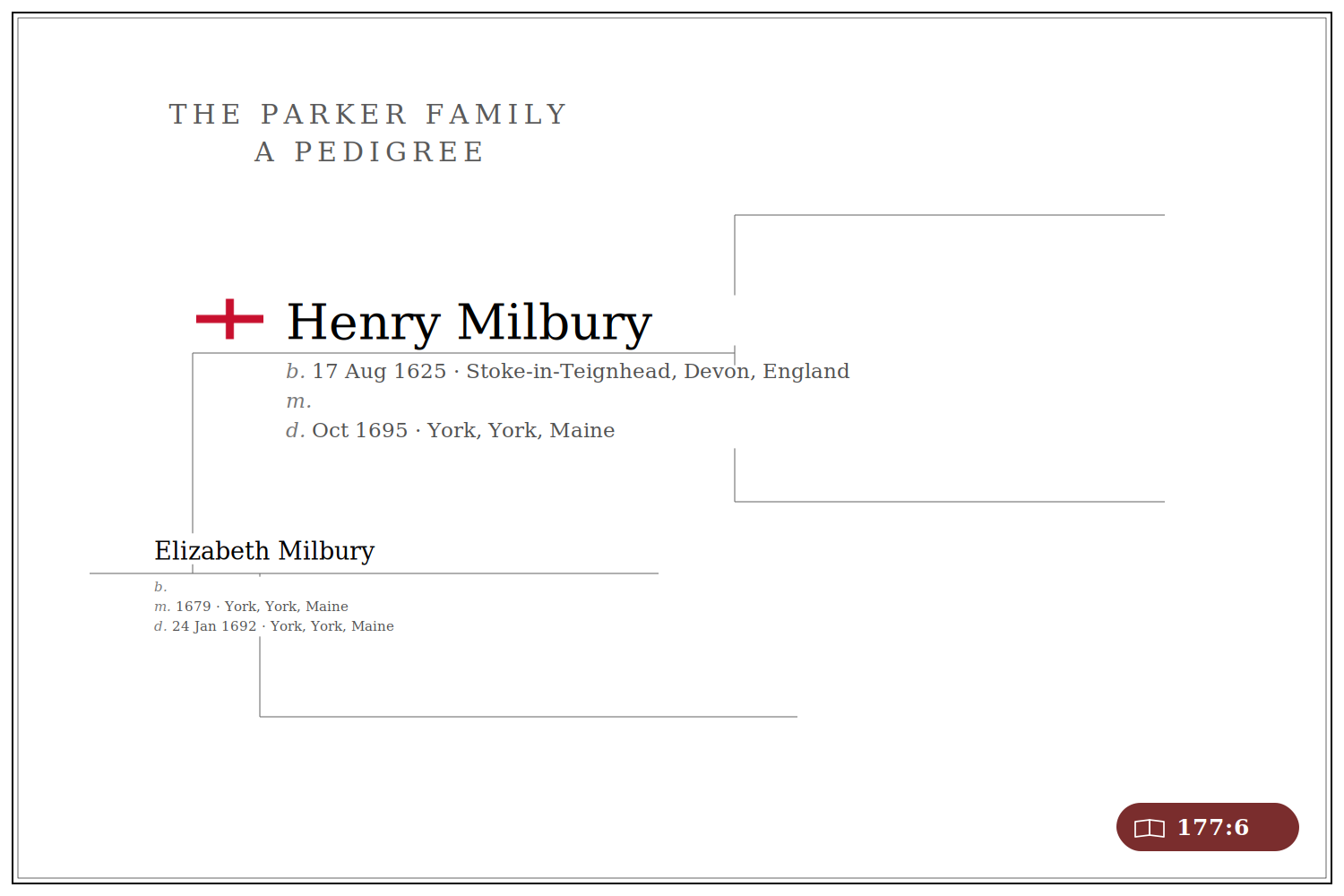
In June 1695 an old man at York sat down to write his will, and somewhere in the middle of the bequests he had to make a decision most people never have to make.
Henry Milbury had to decide what to leave a daughter he could not prove was alive.
Henry was baptized at Stoke-in-Teignhead, in Devon, on 7 August 1625, son of a William Milbury about whom the record knows nothing but the name. He crossed the way half of coastal New England crossed — undramatically, unrecorded. He turned up at York, Maine, and married a daughter of one William Dixon.
(Dixon is worth ten seconds on his own. He came over in 1630 as a servant to Governor Winthrop, and by 1635 he had jumped his bail. In January 1636/7 he bought a house at York and lived in it for thirty years — cooper, juryman, name on the tax lists, dead in bed with a will.
Whatever the governor of Massachusetts wanted him for, nobody in Maine appears to have cared. If these people kept diaries about their feelings, they neglected to leave them somewhere I could read them.)
Then Henry settled into the business of being one of a few thousand people living on the Maine frontier. He farmed on Alcock’s Neck. He took the oath of allegiance in the spring of 1680. He was granted twenty acres in 1691. That is very nearly the complete public record of sixty-six years, and it is the record of a man to whom nothing had happened.
Then, at dawn on a Sunday in January 1692, that stopped.
First, the calendar
The record calls what happened that day the Candlemas Massacre, and the name needs ten seconds too, because it is not English.
Candlemas is 2 February — the Feast of the Purification, forty days after Christmas, the day the church blesses the year’s candles. York did not keep it. Puritan New England had scrubbed the holy-day calendar down to the Sabbath and a couple of civil fasts, and 24 January 1691/2 was a Sabbath: the minister, Shubael Dummer, preached that morning to a congregation that had no particular feeling about candles.
The French did keep it. And the French were on the Gregorian calendar, ten days ahead of the Julian one England was still using, so the day York experienced as Sunday 24 January was, to the men coming through the snow, 3 February — Candlemas and a day. The massacre is named for a feast the dead did not observe, on a calendar they did not use. The name arrived later, from the other side.
Then, the raid
Somewhere between 150 and 300 Abenaki and Canadians, under the Penobscot sachem Madockawando and the priest Louis-Pierre Thury, came into York through the snow and took the town apart. They burned the undefended houses along the north bank of the York River, which was where the town was. Dummer was killed.
The dead were counted at about fifty by Banks, who assembled the casualty list; other accounts say a hundred, and the honest answer is that nobody knows. Roughly eighty people were marched north toward Canada, in Maine, in January.
Henry Milbury lost most of his family between dawn and the end of that day.
His daughter Elizabeth — killed. Her husband, Thomas Payne — killed. His brother Richard, who had been baptized in the same Devon parish sixty-three years earlier and had followed him to the same town — killed. His daughter Dorothy — taken. His granddaughter Bethia, eleven years old — taken. His grandson Samuel — taken, or so it was reported. His son William was already dead.
Three and a half years later, nearing the end, he wrote his will. Not one of them had come back.
The document
When he came to Dorothy he could not write her down as living and could not write her down as dead, so he wrote her down as both:
Unto my Deer Daughter now In Captivity with the Indians Dorothy Millbury I will & give the Summ of five pounds, In case she return by gods good Providence from captivity, but if not till then to be paid which Legacy I Intend not payable by my Son at all if she never return.
A will is a document for settling known quantities. It exists to convert a man into a list. Henry got most of the way through his list and then hit a line item the form does not accommodate, and rather than guess, he wrote a contingency: five pounds, conditional on an outcome no one alive could report, payable never if the condition failed.
A few lines down, three grandchildren. My two grand children Bethiah Pane & William millbury ten Shillings apeice. William was the son of the son who had died; he was in York, and could be handed the money. Bethia had been in Canada for three and a half years. They are named together anyway. My Grandson Samuell Pain the Sum of ten Shillings sits by itself, on its own line. Whether that means anything, I can’t tell you.
The will was proved on 1 October 1695. Henry was dead inside four months of writing it, still holding the question.
What nobody wrote down
Which leaves seven years, and we do not know one thing that happened in them.
Neither woman wrote anything down. Dorothy’s entire file is two entries — she appears as a captive on a numbered list of prisoners held in Canada, at page 78, and she is recorded as having returned. Bethia’s is a redemption date. Between the two ends of each there is nothing. No letter, no deposition, no line in a French parish register that anyone has yet turned up.
What there is instead is a genre, and the genre is the reason we know anything at all about what those years were like for anybody. The captivity narrative: the ordeal, the providential hand of God, the spiritual lesson wrung out of the suffering. Mary Rowlandson published the template in 1682 and it sold like nothing else in the colonies. If you were lucky enough to come back, you gave the world your testimony.
Neither of these two gave anybody anything. But other people did — from the same war, the same coast, and in some cases the same raiding parties — and while none of it can tell us what happened to Dorothy and Bethia, it tells us what the range was.
Hannah Swarton was taken at Casco Bay in May 1690, twenty months before York, and walked to Quebec. She was put in Indian dress, one pair of shoes, no stockings, and the arrangement was that she kept their pace or was killed where she stopped.
Her feet were cut by stones and by ice, and she said that many times she thought she could go no further, and that if they meant to kill her they could kill her. She was on the move from May to February. The York captives walked in January.
What waited at the other end was not one thing. Swarton was handed along, begged provisions off a French housewife, and was eventually ransomed out of Abenaki hands by the wife of the Intendant of New France — the colony’s chief administrator, second only to the governor.
She was given French clothes, taken to the hospital, bled and physicked and looked after, and made a servant in the house, and she said the French were as kind to her as she could have expected the English to be.
She also spent five years under steady pressure to convert, which is the part Cotton Mather cared about when he printed her account in 1697. A good deal of the piety in the printed version is probably his rather than hers.
John Gyles got both ends of it. Taken at Pemaquid in August 1689, aged nine: six years with the Maliseet, then sold on to a French seigneur on the St John River, then freed in June 1698 — one year before Bethia came home.
He wrote his own account and published it in 1736, and it refuses to resolve into a thesis. It holds the French household that treated him decently at the end, and it holds his own brother, burned to death for trying to escape.
And underneath all of it runs the thing the narratives are structurally incapable of showing you, because the people it happened to never came back to write one.
A woman from Oyster River was taken in 1689 with two daughters, and all three of them stayed. The widow married Edward de Flecheur in Canada in 1710. Her daughter Judith, born 1676, was baptized there as Marie Magdeleine, married Jean le Conte in 1698, and was buried in 1703 — a whole adult life, in French, in the parish books of a country she had been carried into at thirteen.
Swarton herself got out in 1695; her daughter Mary did not, and was rebaptized Marie Souart that February, and was still on the list of those left behind when her mother’s ship sailed.
The pattern is age. Adults were ransomed, listed, exchanged and shipped home. Children taken young were absorbed — baptized, renamed, married into a parish — and after enough years there was no particular reason left to go. That was not the system failing. That was the system, and the paperwork is in French because the people ended up French.
Bethia was eleven going in and eighteen coming out, which is precisely the profile that usually didn’t come out at all. Everything about her file says she should have become somebody’s Marie.
So here is the entire honest contents of those seven years. Two women walked a few hundred miles in winter with the people who had just killed their family, lived through something in a small colony that had a documented interest in keeping them, and then declined to stay. Whatever was asked of them, they didn’t take it. I’d rather hand you the hole than fill it.
Afterward
Bethia was redeemed to Casco Bay in January 1698/9, after seven years, at eighteen — into a province that had burned down around her when she was a child. The war had ended by treaty the previous September, which is probably the mechanism: less bought back than handed back, in the general accounting.
Dorothy came home too. The date isn’t in anything I’ve got — only that she returned, and that in October 1702 the York court recorded her marriage to John Grant. Which is the sort of ordinary sentence that only reads as a miracle in context. The five pounds became payable.
And then the paper closes over her again. No death, no burial, no further entry of any kind. She outlived the worst day her town ever had, walked back out of Canada, got married, and the record lost interest in her.
Samuel never appears again either. No Canadian record, no redemption, no return. The most likely reading of that silence is not a good one.
Bethia had a testimony to give and a market ready for it. What she left is a conveyance. On 5 December 1711, thirty-one and single, she deeded her dead father’s 1683 land grant to her uncle Richard Milbury, with full warranty. It is the only document of hers we have. (Full warranty, too. She wasn’t leaving her uncle exposed to a title dispute.)
She married Joseph Preble, born at York in 1691 and eleven years younger than she was — whose grandfather was the immigrant Abraham Preble, who reaches me twice: once here, on my father’s side, and once by a completely separate line down my mother’s to Nana, whose own mother was a Preble. Two arrivals, three hundred years, one man.
A daughter, Hannah, in 1714. Bethia died at York in May 1724, around forty-four, in the town she had been dragged out of at eleven.
She could have written the bestseller. The century wanted a testimony out of her and would have paid for one. She gave it a daughter and a deed instead. After what the records had already done to her family, I can see the appeal of being unremarkable on purpose.
Sources. Genealogical Dictionary of Maine and New Hampshire (Noyes, Libby & Davis) — the Milbury, Payne, Dixon and Preble families, and the Canadian marriages and baptisms of captives who did not return. Henry Milbury’s will, 10 June 1695, proved 1 October 1695, York County probate (Maine Wills, 1640–1760) — the source of the clause the post is named for. Charles Edward Banks, History of York 1:271 — the raid and the casualty list. A Narrative of Hannah Swarton, printed by Cotton Mather in Humiliations Follow’d with Deliverances (Boston, 1697). John Gyles, Memoirs of Odd Adventures, Strange Deliverances, &c. (Boston, 1736). The Irving Preble Genealogy, register no. 19 — Bethia’s marriage to Joseph Preble and their daughter Hannah, 1714. The York County deed of 5 December 1711 by which Bethia conveyed her father’s grant.
Podcast: Play in new window | Download