For about a week, Ancestry.com was confident I was from New Jersey.
It had me descending from a woman born in Marlton – which I assumed was in Scotland, but a quick consult of the altas turned out to be a city in New Jersey, fifteen miles from Philadelphia, named after marl, a green clay full of crushed shell that local farmers spread on their fields as fertilizer.
There is no Marlton in Scotland. There never was. The whole thing arrived in my tree the way these things always arrive: a bum merge, somebody else’s bad data welded onto mine by a hint I should not have accepted, quietly relocating a genuine Scottish ancestor to a Philadelphia suburb named after dirt enhancer.
It’s even funnier once you know I’d spent my whole life certain that it was being a MacDonald that made me Scottish.
My grandmother was Marion Louise MacDonald — Nana — and honestly her name did most of the work. You hear MacDonald and you picture heather and a tartan and somebody being treacherous to somebody else at a dinner party in 1692. I never questioned it. Of course I was Scottish. Look at the name.
But the MacDonalds had not been in Scotland for a long time. Donald MacDonald came across on the Hector — the ship that dumped a couple hundred Highlanders at Pictou, Nova Scotia, in 1773, three years before there was a United States.
By the time anyone in my family was alive to tell me I was Scottish, the MacDonalds had been Canadian for well over a century. John @#$@#ing George MacDonald — my great-great-grandfather, the brick wall, the man Nana spent twenty years of her life trying desperately to trace past — was born in Nova Scotia and died in Nova Scotia.
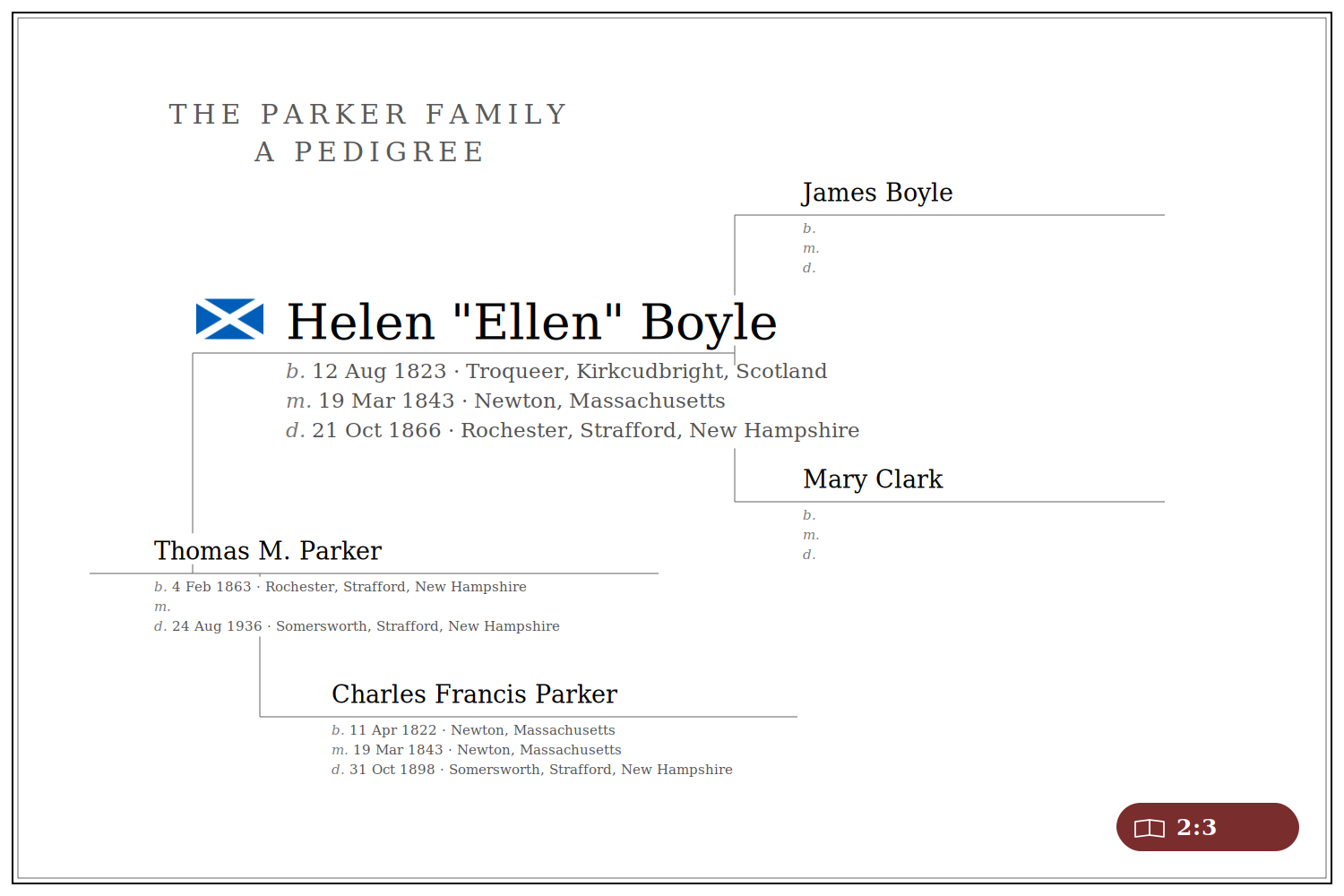
So when Helen “Ellen” Boyle (1823-1866) was actually on a boat, leaving actual Scotland, John George was technically a seven-year-old Canadian. My Scottish grandmother’s people had left Scotland three generations before my supposedly-not-Scottish grandfather’s people got off the boat.
Ellen Boyle is on the Parker side. The side with the flat, unbothered English name that nobody ever accused of being from anywhere.
Nonetheless, she was baptized in 1823 in Troqueer, Scotland — a parish on the west bank of the River Nith, just south of Dumfries, in the old stewartry of Kirkcudbright. That’s Galloway, the bottom-left corner of Scotland, the part that never makes it onto the shortbread tin.
Through her childhood, Ellen’s family moved between three Galloway parishes — Creetown out on the granite coast, Troqueer, and Kirkpatrick Irongray inland — the itinerary of people chasing work that keeps not lasting. Her father James did a stretch in the Kirkcudbright tolbooth, the town jail, which in that time and place held one main category of guest: men who owed money. (I looked for something more dramatic. There isn’t any.) He died in Scotland. So did her mother, Mary.
Galloway in the 1830s and ’40s was a place you left. The handloom weavers who’d anchored the local economy were being ground out by the power looms in the cities. Wages collapsed. When Parliament studied the misery, one of the remedies its experts formally recommended was that the weavers simply emigrate.
The government’s official advice was leave.
Two of the Boyle children didn’t look back. Ellen sailed to Massachusetts and married Charles Francis Parker in Newton in 1843 — a Yankee, born there in 1822, no Scotland anywhere in him. Ellen’s brother went to a mill town up in Strafford County, New Hampshire, married a local woman, and dissolved into rural manufacturing without a ripple. The parents stayed, and died, and that was the end of the Boyles being from anywhere.
It worked because Ellen was built to vanish. Lowland Scots came with the full assimilation kit — Presbyterian, English-speaking, literate — and dropped into Protestant Yankee New England like they’d been ordered from a catalog.
She married her Yankee Parker in Newton, and then the couple drifted north to Rochester, New Hampshire — the same Strafford County mill country her brother had landed in. Both Boyles who got out ended up in the same corner of the same state. And, within one generation Galloway was simply gone: the tolbooth gone, the three parishes gone, the granite coast gone.
So here’s the full stack, and I’d like a moment to appreciate it. The branch where diversity meant being born 10 minutes, 20 minutes, or 60 minutes outside of Boston brought me the ancestor with the most recent claim on global citizenship.
She grew up there, left there, crossed an ocean to get out — was sitting quietly on the branch with the boring English name. And when I finally went looking for her, the machine briefly and confidently informed me she’d been born in New Jersey.
In a town named after fertilizer.
I think she’d take it as a compliment. Vanishing was the whole idea, and turns out she was very good at it.