Tag: Hayneses

  • The Coward Test

    The Coward Test

    The oldest man on the road to Lexington that morning was seventy-eight, and the last thing he did with his life was threaten to call his cousin a coward.

    His name was Josiah Haynes, deacon of the Sudbury church for forty-two years, and on 19 April 1775 he heard the same alarm everyone west of Boston heard. The alarm wasn’t the patriotic fairy tale we hear about “The British are coming,” but instead the much more ominous “the Regulars are out” — the British army was marching out of Boston.

    Haynes got dressed, said goodbye to his family, and walked into a war. At age seventy-eight, he did not have to. Massachusetts enrolled every man from sixteen to sixty, and Josiah had cleared that ceiling by eighteen years. Nobody was coming to his door with a musket and a grievance if he stayed home and let the young men handle it. He went anyway.

    What happened that day were the first shots of the American Revolution. The British marched out of Boston to seize the colonists’ guns and gunpowder, and the colonists … declined to hand them over. What came next was an all-day firefight that turned into an eight-year shooting war that ended with a new country. This was the morning it started.

    Josiah, the dead Sudbury deacon, isn’t, strictly, mine. Josiah is my first-cousin-blah-blah-times-removed, or some such incantation that means related but off to the side.

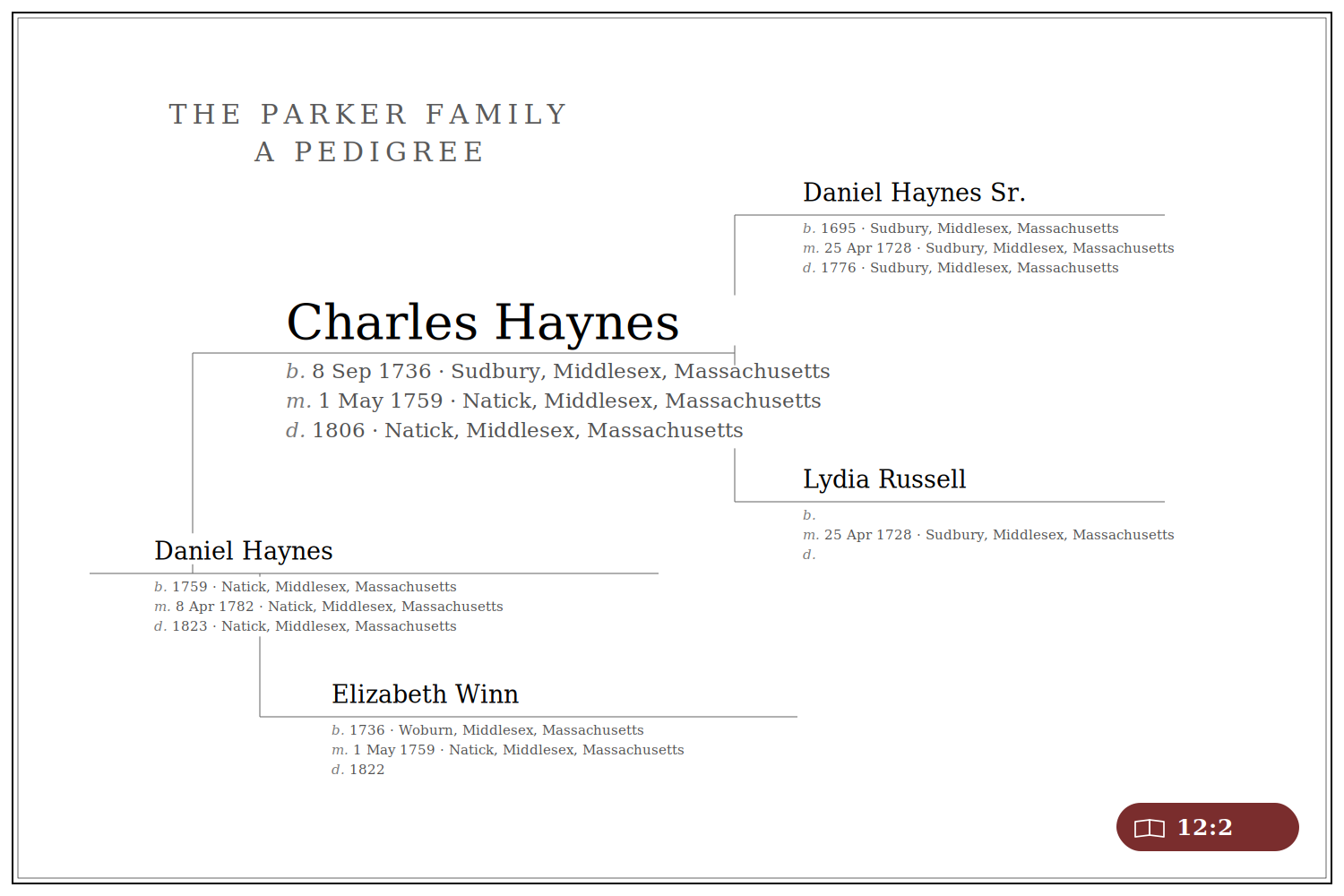
    The man who is mine is Charles Haynes (1736–1806), my great-great-great-great-grandfather, who marched out of Sudbury that same morning at thirty-eight.

    The Haynes name walks into the Parkers through Abraham Parker’s wife Mary Haynes — the same Abraham I’ve written about before, the one who taught me the difference between fact and hope — then quietly disappears, which is the usual fate of a surname that didn’t win the patriarchy coin toss.

    What you need to know about Sudbury in 1775 is that it was lousy with Hayneses. The town turned out wholesale, and a frankly unmanageable fraction of the men in the column shared one of about six first names and exactly one surname.

    One company marched under Charles’s second cousin, Capt. Aaron Haynes. Somewhere in the ranks was a Joshua Haynes. There was the deacon, Josiah. (The casualty list that day couldn’t keep the Hayneses straight either, which I point out to say that mixing up people with the same name is not a problem I invented.)

    The Sudbury men got to Concord and found the company under orders not to start anything.

    This did not sit well with the deacon.

    When the captain (his Haynes cousin, remember) held back at the bridge, the old man rounded on him — if you don’t go and drive them British from that bridge, I shall call you a coward — which is, when you sit with it, an extraordinary thing for a seventy-eight-year-old deacon to say to an armed officer thirty years his junior on the first morning of a war.

    Then the British turned around and tried to get the hell outta Dodge, and the road home became a twenty-mile gauntlet.

    The militia caught the column at Merriam’s Corner and never let go — firing from behind stone walls, from doorways, from the tree line, melting back and reappearing a quarter mile on. It was the opposite of a battle. It was a slow, ugly, deeply effective bleeding-out of a professional army by farmers who knew the ground.

    Somewhere along that running fight, reloading, our deacon was shot. He was one of two Sudbury men killed that day, and one of roughly forty-nine Americans dead by nightfall.

    The records refuse to tell us where Grandfather Charles Haynes was in the fray. But presumably he and the rest of the Haynes army pushed the redcoats into Parker’s Revenge — the payback Capt. John Parker laid on the British for the blood spilled on Lexington Green that morning. (As for whether Capt. Parker was a cousin — now that I’m recovered from my Abraham Parker fiasco, I’m ready to be hurt again, so, yes, I’m absolutely certain he’s related.)

    The rolls of who did what that day are a mess — they can’t keep Josiah and Joshua apart, never mind everyone else. For a long time I wrote Charles to the margin of his own family’s day, hedging, probably present, because I didn’t have the paper. But that was me applying a courtroom standard to a thing that doesn’t need one.

    The honest read is the obvious one: a thirty-eight-year-old Haynes, in a town turning out to the last man, in a clan that marched under one cousin and buried another — and presided over by an octogenarian deacon who would publicly call you a coward for hanging back — was on that road. The deacon would have made damned sure of it.

    So the Hayneses marched out together, and that evening the rest of them walked home. The deacon didn’t. Charles did — which is the only reason I’m here to tell you he was missing a man.

    But walking home only bought him the first day of eight years. Bunker Hill was two months off, and the war he’d marched into that morning had years left to run.

    The line runs through the one who walked back, the way it usually does. They named a school after the one who didn’t.

    Sources. Walter Haynes, Haynes Genealogy (1928), no. 151 — patriline and descent. Charles Hudson, History of Sudbury — Deacon Josiah Haynes’s death at Merriam’s Corner and the exchange that gives the post its name. Natick and Sudbury, Massachusetts vital records — the Haynes–Winn marriage, 1759. Josiah Haynes’s gravestone and his Find A Grave memorial, the latter carrying the rival version of the “coward” line that this post sets aside.

  • The Difference Between Fact and Hope

    The Difference Between Fact and Hope

    Abraham Parker was the first ancestor who ever told me to go to hell.

    Well, not in so many words — when he died 160-odd years ago, he left me almost nothing to argue with. That was the problem. He left me pretty much no trace at all.

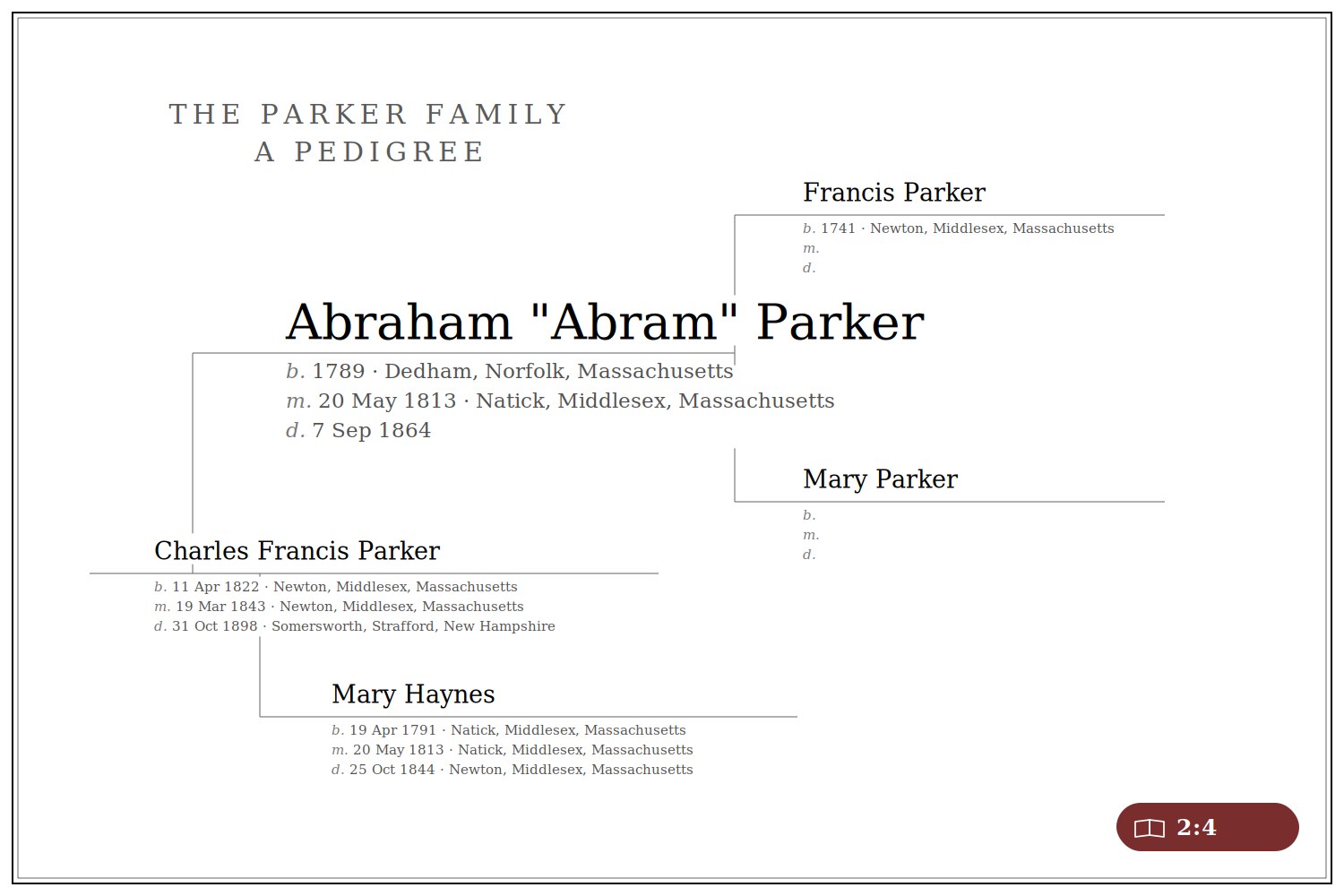
    Getting to him was easy. He’s my great-great-great-grandfather, and every link from me to him is a Parker: my father, his father, his father, his father, then Abraham (1789–1864). Married Mary Haynes in Natick in 1813. And then the trail just stopped.

    It stung in a way I didn’t expect, because Abraham was a Parker. My Parker. By blood he’s no more mine than a Titus or a Pike or a McCrillis — same fraction of me, same distance back. But Parker’s the name I ended up with.

    It’s the name on my driver’s license, it’s the name on the email signature, and yet here Abram was cruelly slamming his genealogical door in my face.

    It wrecked me a little. It also kept me up for weeks. So I did what every beginner does when a wall won’t move.

    I forced it.

    Here’s how you force it. You pattern-match on names — and the colonial records are lousy with the same dozen first names. You line the candidates up, and you “eliminate” all of them but one, and then you announce that the one left standing has to be right.

    When I did this, Abraham’s father was Elijah Parker of Freetown, his grandfather was Capt. Elisha Parker of Scituate. And a couple levels (and marriages) behind Elisha, a pot of gold: a Mayflower passenger, a couple of names straight out of The Crucible, a Longfellow cousin if you squinted.

    I’d proved it. Proof by elimination. I was so sure.

    I also knew, in the part of my brain I’d stopped listening to, that I really hadn’t eliminated all the possibilities, I just wanted so badly for it to be done and true that I was … stretching. Stretching has a shelf life. It lasts right up until the moment the Catholic-Judeo guild sets in, and you start looking for something else that could be right.

    And then I found something else.

    The real answer was quieter than the stretch. After another two weeks of banging my forehead on the desk, it turns out Abraham’s father was Francis Parker of Newton — son of Enoch Parker, a Harvard schoolmaster.

    Behind Francis? No Mayflower, no witches, no poets. Just a documented line of boring-but-safe Parkers whose only excitement seemed to be moving from Newton to Dedham and back every two or three generations.

    The proof is unglamorous, and solid but not ironclad. The 7 Sep 1845 Roxbury marriage record names Abraham a “widr., a. 56 y., mason, s. Francis and Mary.” The Newton, Dedham and every other source of vital records within walking distance hold exactly one Francis of the right generation. He was born to an Enoch, and he married a Mary. No rival candidate anywhere.

    It isn’t a bolt of satisfaction lightning when it doesn’t come with a single dramatic document that closes the case in one stroke — but I’m learning that type of Indiana Jones #$@# doesn’t happen.

    The truth came the way most honest pre-1850 answers come, finding one path through the trees where all the records line up, and none of the two-weeks of subsequent records crushes your dreams of leaving this branch and moving on to the next person.

    But my flirtation with the other Abraham did cost me. I had fallen in love with my false Parker family tree.

    I loved my very own Mayflower hit (Henry Samson). I loved that I was related to a Hilton (Hannah, not Paris). I even loved the creepy girl who lied about witches in Salem and helped send a half-dozen people to the gallows (Mercy Lewis, via her sister Priscilla).

    So Abraham. The first ancestor I wanted so badly to be someone that I nearly made him someone else — and the one who taught me the difference between a fact and a hope.

    But in the end, that Abraham told me to go to hell, and it’s taken me months to fully realize that was the lesson.

    And it’s awkwardly fitting that the ancestor who taught me to wait for the truth instead of inventing it was the one whose name I’d been carrying the whole time.

    Hopefully, because i’ve now learned it first on my own name, it’ll stop me from screwing up anybody else’s.

    Sources. The 7 September 1845 Roxbury, Massachusetts marriage record — Abraham entered as “widr., a. 56 y., mason, s. Francis and Mary,” the document that names his parents. Newton, Massachusetts vital records — the single Francis Parker of that generation, son of Enoch, married to a Mary. Natick, Massachusetts vital records — Abraham’s 1813 marriage to Mary Haynes.