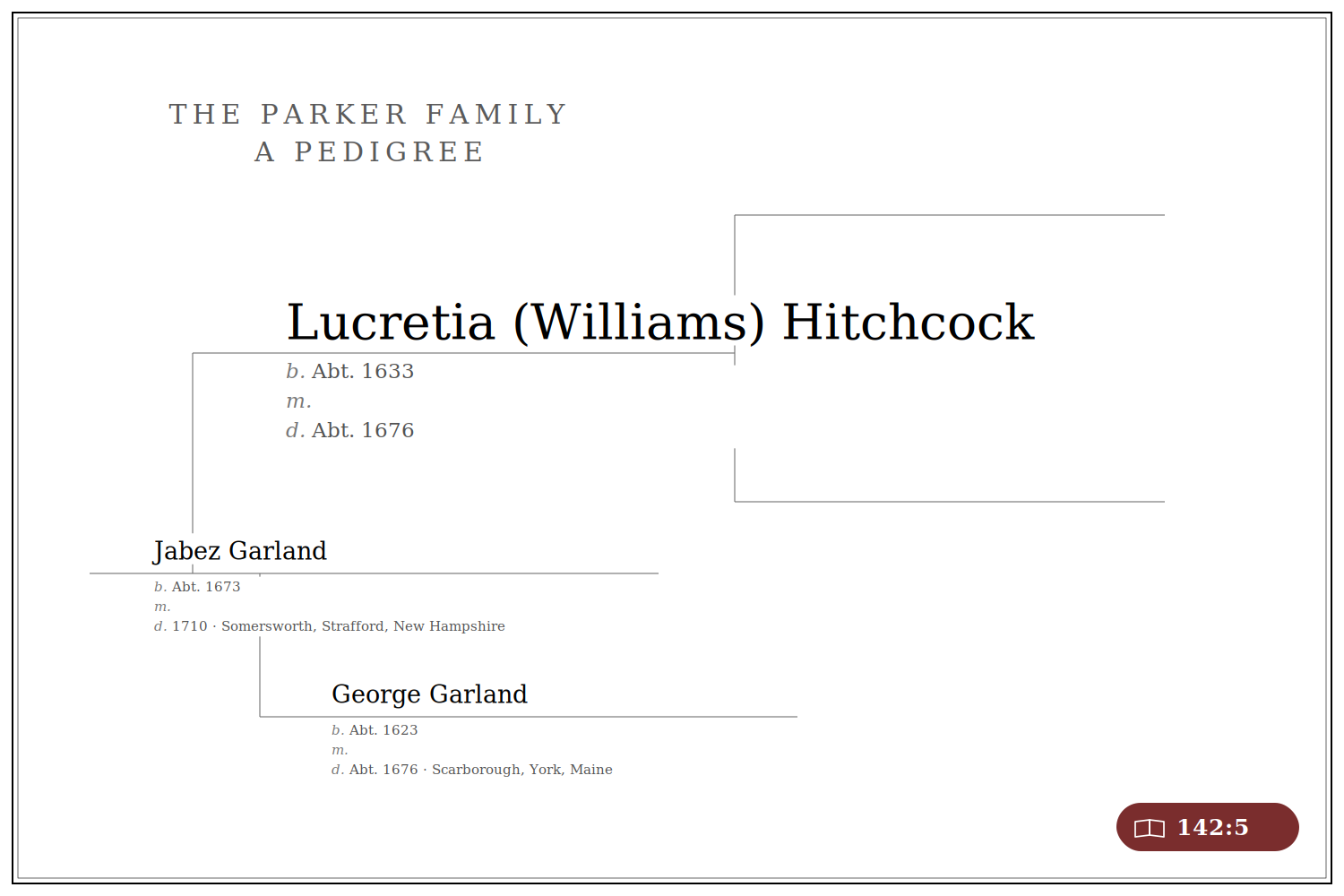
The first solid fact anyone wrote down about Lucretia is how she died, and it doesn’t use her name.
In 1677 the minister William Hubbard published his account of King Philip’s War, and somewhere in the eastern campaign he set down a single sentence: a Mrs. Hitchcock was carried off captive from Saco and died the following winter from eating a poisonous root in place of ground nuts, as the Indians reported afterward.
No first name, no age, no further comment. A captive woman got hungry enough in the woods to dig up and eat something that killed her, and the only reason it’s recorded at all is that her captors mentioned it later and a minister found it worth half a line.
So you go looking for who she was, and the problem is the same as always. Women are almost impossible to find except through the men standing around them.
In this case, her name was Lucretia Williams, and she’s my grandmother about 10x greats ago.
She’s a daughter of Thomas Williams of Saco, which we know because the record tracks her father, not her. She married Lt. Richard Hitchcock and gave him a houseful of children — Jerusha, Thomas, Lydia, Rebecca, Ann, Margaret — which we know because the record tracks her husband and his estate. Then Richard died, and she became, in the documents, “the widow Hitchcock.” A daughter, a wife, a widow.
Three men deep and we still don’t have a sentence that’s actually about her.
When she becomes more visible — genuinely, repeatedly, in the court files — the reason again fails the Bechdel test. She took up with George Garland (my great-nth-grandfather), and the Province of Maine could not leave it alone.
George was a tenant farmer at Nonesuch, and he came with baggage. The court had been after him since 1662 for frequenting the house of a woman named Sarah Mills, on the suspicion that he already had a wife back in England.
(A man with a wife on the far side of the ocean shopping for a second was a known genre.)
They indicted him and Sarah for living together in 1665, indicted them again in 1668 and ordered them to marry inside the month. In the same season they had Sarah, entered in the record as “a known vagabond Quaker,” whipped from town to town, Boston to Scarborough.
Then, when George and Lucretia were trying to settle down and make me some grandparent, the court forbade George from marrying Lucretia, on the grounds that he was still “owning himself Sarah Mills’s husband.”
He had never married Sarah. He could not marry Lucretia because he had not married Sarah. The trap was airtight and the colony was proud of it.
Lucretia and George answered by ignoring the ruling. He took a public flogging for it. The record notes that despite the proceedings and the whipping, “their relations continued until her death.” They had a son (life finds a way) named Jabez, who was born square in the middle of the prosecution.
The colony generated a longer written record of whose bed Lucretia Williams was in (though, technically, it was George because he’s a man) than it ever generated about Lucretia Williams.
The government knew the cohabitation, the dates, the prior entanglement, the precise legal reason she could not marry the father of her child — and it never once thought to set down who she was. The government was exhaustively, litigiously interested in regulating her sex life and completely uninterested in her. Getting out of the bedroom was not a frontier the seventeenth century hadn’t reached. They reached for the inside of that cabin with both hands and a docket.
And the thing that ended it cared about none of it.
In September 1675 the war came east and the Wabanaki hit Saco. Major Phillips’s garrison house took the brunt — fifty people inside, ten of them able to fight — and Hubbard treats its survival as a small miracle. They were besieged, outnumbered, the buildings burning, and yet not one of the fifty killed.
God, he writes, does not fail those who trust His power.
Then comes the next sentence, the one about Mrs. Hitchcock and the root. The providence that spared fifty did not extend to the woman carried off from the same yard.
George drops out of the record at the same moment, most likely killed in the same raid. The court spent thirteen years failing to separate these two. The war managed it over a single winter.
The colony had wanted, more than nearly anything, Lucretia’s name on a piece of paper — a banns, a marriage record, something filed and proper. It never got it. The one document that finally records her, the half-line about how she died, doesn’t give her first name either. To the court she was the widow it couldn’t marry off. To the war she was “one Mrs. Hitchcock.” Both of them looked right past her to the man in the frame.
She left no will, no deed, no signature, no first name in the record of her own death. She left a line of descendants by the one man she was legally forbidden to have. It’s the most personal thing in the file, and it’s the only thing nobody had to write down.
Sources. The Genealogical Dictionary of Maine and New Hampshire (Noyes, Libby, Davis) for the Williams, Hitchcock, and Garland families and the court record — the 1662–1672 prosecutions, the 1672 forbidding of the marriage, George Garland’s flogging and disappearance — citing the Province and Court Records of Maine. William Hubbard, A Narrative of the Troubles with the Indians in New-England (1677), for the September 1675 attack on Saco, Major Phillips’s garrison, and the death of “Mrs. Hitchcock” by poisonous root; the identification of her as Lucretia is the Dictionary‘s.
Podcast: Play in new window | Download