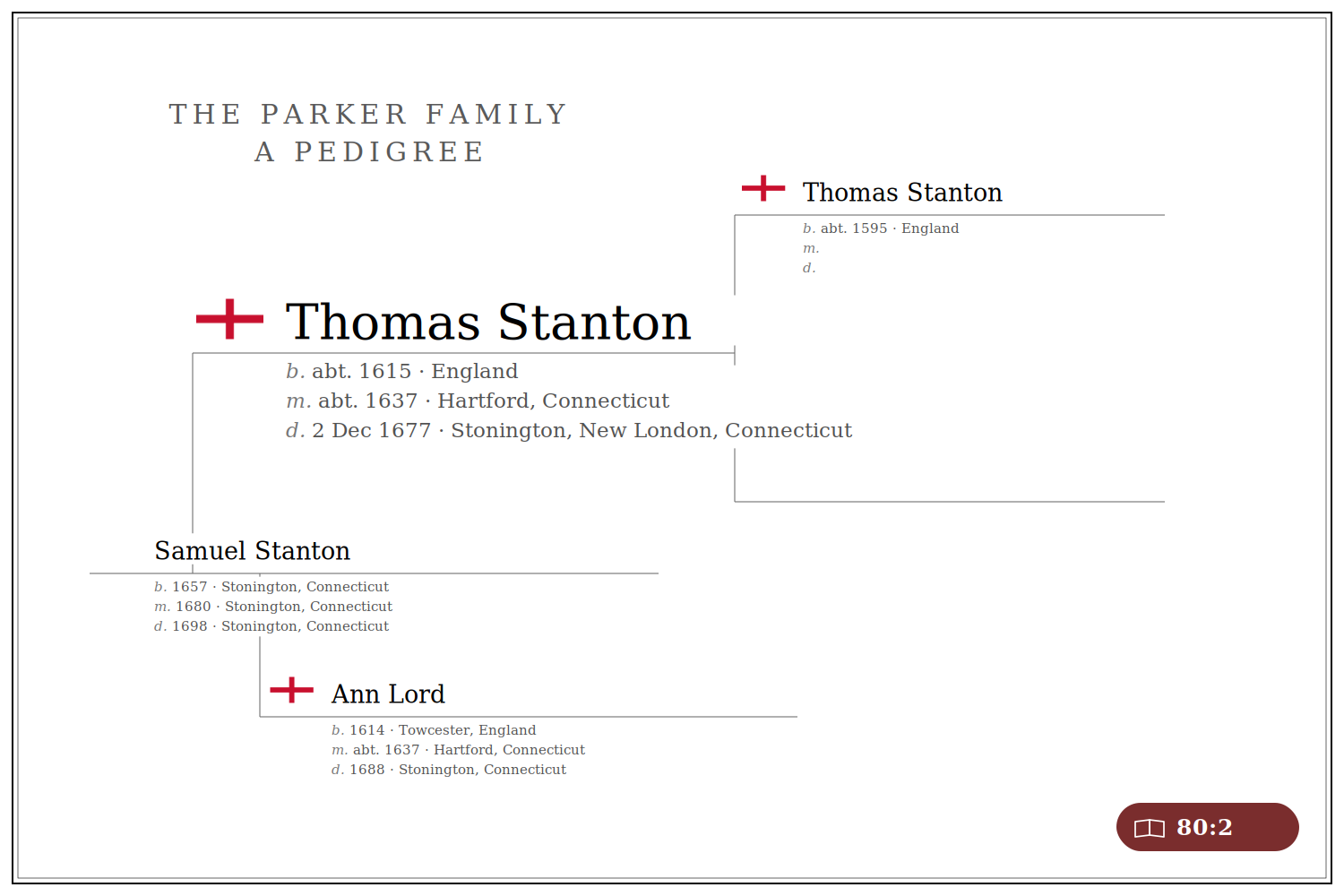
Most of my ancestors are a line on a chart. A lucky few left enough of a paper trail that I can wonder what in the actual #$^%& were they thinking.
Thomas Stanton (abt. 1615–1677), my eighth-great-grandfather, sailed from London in 1635 at twenty. Within a year he had taught himself Algonquian — one of the few Englishmen in the colony who could speak to the people whose land the colony was taking. By 1636 he was John Winthrop Jr.’s interpreter.
The language was his career, and it made him useful to the English who faught what the called the Pequot War.
Before dawn on 26 May 1637, English forces under Captain John Mason and their Narragansett and Mohegan allies surrounded a fortified Pequot village at Mystic, set it on fire, and shot the people who tried to escape.
The warriors were mostly away. The village was women, children, and the old. Between four and seven hundred people were burned or killed in about an hour; two Englishmen died.
The Narragansett and Mohegan who had come with Mason were sickened by it and went home. The English wrote it down as the will of God.
The next year, the Treaty of Hartford ordered the survivors sold into slavery or handed to the victors, and forbade them to return to their land, to speak their language, or to call themselves Pequot.
That is the war Thomas Stanton interpreted.
On a march after Mystic, as the English burned Pequot homes as they went, two Pequot men stood on a hill and shouted at the column. Stanton — “marching at liberty,” moving free of the ranks — asked leave to fire on them. The captain refused.
Stanton was not a reluctant man dragged along by his usefulness. Given the chance to kill, he asked for it.
A few weeks later, English forces trapped a large group of Pequot in a swamp near Fairfield. Stanton went in to talk to them. He was trusted, and he spoke their language, and he used both to bring close to two hundred old men, women, and children out of the swamp. They were sold into slavery.
Connecticut made him its first official interpreter in 1638. The United Colonies put him on retainer for all of New England, and by 1658 he was Interpreter General. He was the English voice at the treaties, the surrenders, and the land transfers across southern New England.
The conquest needed someone to make its terms understood to the people it was dispossessing. That was his job.
The record also shows him, later, arguing that the defeated tribes be treated fairly, and protesting the reparations the commissioners kept extracting from them years after the fighting stopped. And it shows Uncas, the Mohegan sachem, coming to Stanton’s house to have him write his will.
He marched at liberty — no one made him. It was his job, sure, but he chose it, and stayed in it for 40 years.
Sources. John Mason, A Brief History of the Pequot War — the Mystic fight and the line that gives the post its title, Stanton “marching at liberty.” John Underhill, Newes from America — the allies leaving Mystic. Treaty of Hartford (1638) — the terms imposed on the survivors. The Barbour Collection of Connecticut vital records — the Stonington descent through Anna Stanton. Colony and United Colonies records — Stanton’s interpreter appointments and his post as Interpreter General.
Podcast: Play in new window | Download