Family legend says my five-times-great-grandfather Reuben Wentworth was at Bunker Hill.
He was a forty-five-year-old farmer out of Shapleigh, in the District of Maine, which was not yet a state, just the far north end of Massachusetts. Most of the people who fought on the seventeenth of June, 1775, were half his age.
The stories do not say which company Reuben fought with. This sounds like an unimportant distinction, until you realize that the two options means the difference between “standing on a different hill and listening to it” and “killing several hundred redcoats at forty yards.”
To make matters more confusing, the Battle of Bunker Hill was apparently not fought on Bunker Hill. There are two rises on the Charlestown peninsula, and the militia were sent up to fortify the taller one in the dark. At sunrise, they found themselves dug in on the shorter one: Breed’s.
Nobody has bothered to correct the name of the battle in two hundred and fifty years. File that away. It comes back under oath.
The 30th Maine
Maine sent exactly one regiment to the war that year: Col. James Scamman’s 30th Regiment of Foot, raised out of York County — Kittery, Berwick, York, Wells, Arundel. Reuben’s neighbors, more or less. A return of 9 June puts it at three hundred and ninety-six men fit for duty.
On the seventeenth they marched toward the guns. They did not arrive.
Somewhere on the Cambridge road they met two men on horseback who said the regulars were landing at Lechmere’s Point, so the regiment went to Lechmere’s Point. There they ran into Col. John Whitcomb, who was acting as a general officer that day, and who testified against them the following month:
“I asked him what brought him there, he replied by asking me where he should go. I told him where he could do the most service.” Two colonels in a field, one asking the other for directions to the largest event of both their lives.
Scamman understood the answer to mean a hill. There are, in the vicinity, several. He picked a small round one a mile off and stood on it watching the British floating batteries.
How long he stood there is the single most disputed fact in the record. A quarter of an hour, said one ensign. Twenty minutes. Half an hour. Half an hour or more. Three-quarters, said the major, the drummer and the adjutant.
At some point Scamman sent two sergeants over to Bunker Hill to ask whether his regiment was “wanted.”
Then Charlestown caught fire, and that finally did it. Scamman saw the meeting-house burning, and he marched the regiment up Breed’s Hill with all possible dispatch, going in under fire, with the shot flying thick.
Scamman shouted the line he is now stuck with forever: “Come, my Yorkshire lads, now let us show our bravery.”
Unfortunately, his timing wasn’t great. He was shouting the line that would outlive him at a hill the battle had already finished with. Men were coming down past them, saying they had spent all their ammunition. Scamman ordered a retreat and, according to one soldier, “every one made the best of his way off.”
Even a month later, those involved didn’t know the difference between Bunker’s Hill and Brewer’s Hill. Everybody in that transcript means Breed’s. Nobody in it says Breed’s.
Scamman’s court-martial convened 13 July 1775 on a charge of disobedience to orders and backwardness in the execution of his duty in the late action on Bunker’s-Hill. He was acquitted, but was out of the army before the year turned.
In testimony, a Major Daniel Wood was called, and the record notes that the Major could not say any more upon the case, “for he was not so happy as to reach Bunker’s-Hill for the whole day.”
Major Wood lived in Shapleigh.
The 1st New Hampshire
If family legend suggests Reuben actually fought in the battle, we’d have to assume he marched with his western neighbors.
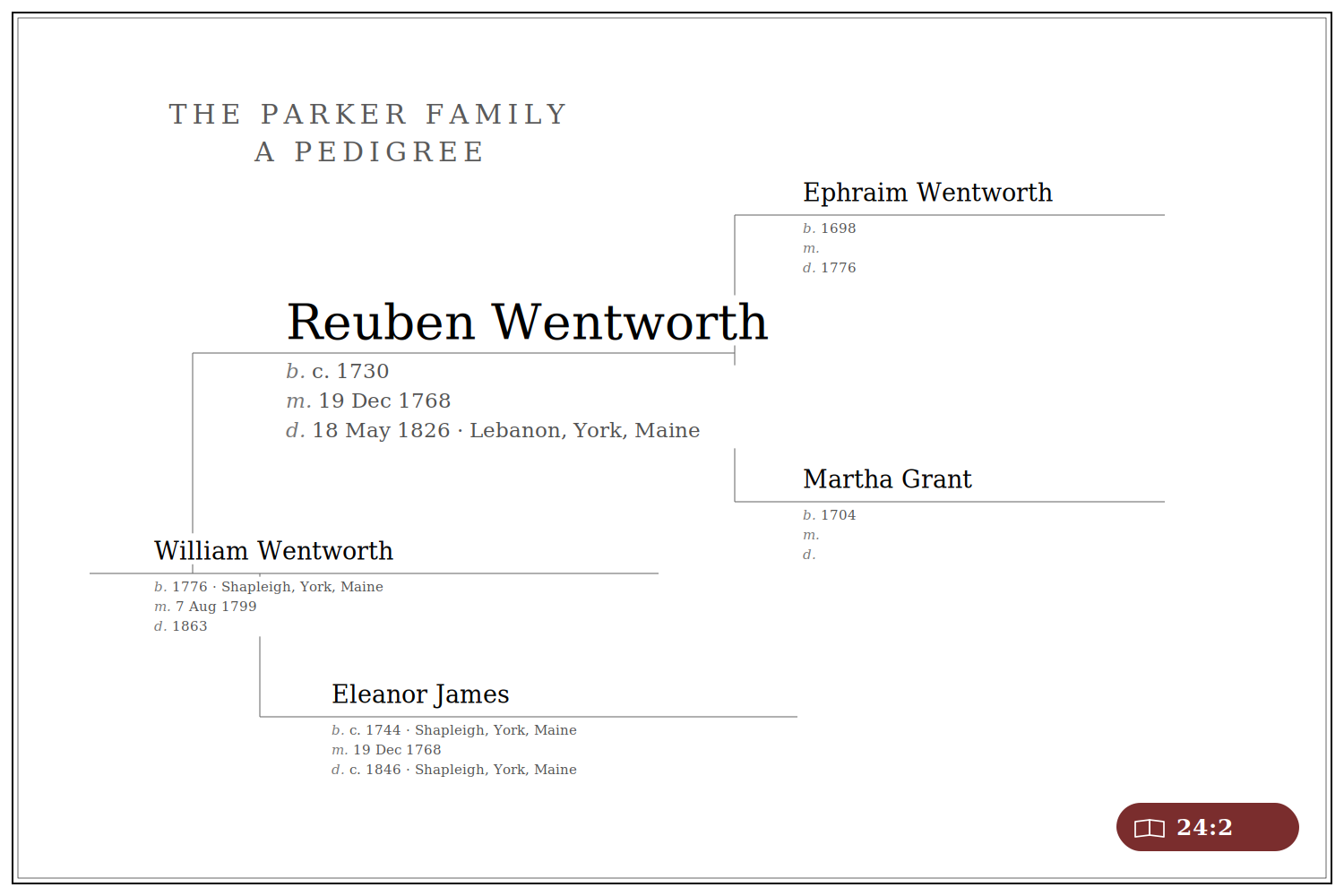
Shapleigh sits on the New Hampshire line. Rochester is a morning’s walk. Men crossed that border for work, for wives and for regiments — Reuben himself married Eleanor James in December 1768 at Somersworth, on the New Hampshire side.
New Hampshire sent Col. John Stark.
The American line on Breed’s Hill ended in the air on the left. Capt. Thomas Knowlton saw it and took his Connecticut men down behind a farm fence — half stone, two rails of wood — six hundred feet back from the redoubt, threw up a second fence in front of the first.
It looked like a breastwork. It wasn’t — in plain words it gave no defensive cover, since all they had to close the gaps in the fence was newly cut hay.
Col. Stark and the bulk of his regiment arrived between two and three o’clock, crossing Charlestown Neck while the ships and shore batteries raked it end to end.
When he arrived, he looked at the ground and saw the thing nobody else had. The fence stopped at the top of the bank. But, below the bank, at low tide, lay a strip of Mystic River beach — a clear road, wide enough to walk a column down.
So he ran the fence down the bank, and at the bottom his men threw the beach stones into a wall to the water’s edge, in about the time it takes to describe it.
Then John Stark took a stake, walked out in front of his own line thirty or forty yards, drove it into the sand, and told his men: “Boys, the red coats are coming up the hill. If one of you fire a gun till they reach that stake, I’ll shoot him.”
(That one reaches us third-hand — Caleb Stark had it from George Washington Parke Custis, who said he had often heard Washington tell it. Which is a game of telephone, but with the Father of His Country on one end of the line, so I am pretending like it is gospel.)
The British right came down the beach in column at a run — the light infantry, the best they had.
A British officer wrote home two weeks later that their light infantry were served up in companies against the grass fence, without being able to penetrate. Most of the grenadiers and light infantry, he wrote, lost three-fourths of their men the moment they presented themselves, and many lost nine-tenths. Some companies came out of it with eight or nine men. Some came out with three.
The next morning, Gen. Winslow of Boston walked the ground at ten o’clock, before anything had been buried, and counted ninety-six dead in front of that little stone wall on the sand.
None of which was winning the battle. Half a mile to the right the men in the redoubt were down to a round apiece, and Howe sent the third assault in with orders to leave the muskets alone and use the bayonet.
The redoubt fell that day. The rail fence did not. It held long enough for the men coming off Breed’s Hill to get across the Neck, which is the only reason that day was a retreat and not an annihilation. Stark pulled his people out in good order and had to stop them going after the British rear on the way, because they had thrown the attack back so many times they thought they had won.
Then he went home
Let’s be honest about how family legends work.
If Reuben had been down on that beach with 1st New Hampshire, we would know it — fame and glory are not things a family loses track of.
What was passed down through generations was totally devoid of any specifics. In my limited experience, a legend that vague is only vague because nothing in it is worth inflating.
So my money is on Reuben being with the 30th Maine and the little round hill. Either way, he got back to Shapleigh and lived another fifty-one years.
Longevity, not military service, seems to be the fact this family was most interested in keeping. The Wentworth Genealogy of 1878 mentions Reuben made ninety-six, and the book says his widow made it past a hundred.
The rest of his years weren’t any easier than his day in, on or around Bunker Hill.
In Reuben’s sixties, the sea took three of his sons. Reuben Jr. fell from a mast at Wells about 1794. Enoch and John shipped out of Boston in 1797 and did not come back.
The son who carried the line to me was William, born at Shapleigh on 24 July 1776 — thirteen months after the hill, and twenty days after the founding of the country. William’s daughter Sarah was born at Lebanon, Maine, in 1802 and married a Parker.
(William died in 1863 at Grimsby, Ontario, which, for what it’s worth, I am choosing not to read anything into.)
Reuben Wentworth died at Lebanon, Maine, on 18 May 1826, fifty-one years and eleven months after the hill — the part of his life that got remembered, whether true or not.
Sources. The Wentworth Genealogy (1878), v.1 no. 263 — Reuben and Eleanor, their marriage in 1768, his death at Lebanon on 18 May 1826, her death past a hundred, and the three sons the sea took. It is also the family’s authority for Reuben at Bunker Hill. Nathan Goold, History of Col. James Scamman’s Thirtieth Regiment of Foot (Maine Historical Society, 1899) — the York County regiment, the return of 9 June 1775, and the minutes of the court-martial of 13–17 July 1775 as Scamman himself published them in the New England Chronicle or Essex Gazette, bracketed remarks and all. Richard Frothingham, History of the Siege of Boston (1851) — Knowlton’s hay-stuffed rail fence, Stark’s stone breastwork on the Mystic beach, and the British letters on what the light infantry lost there. Caleb Stark, Memoir and Official Correspondence of Gen. John Stark (1860) — the crossing of the Neck, the stake in the sand and its chain of custody, and the ninety-six counted dead the following morning. Maine and New Hampshire vital records — the 1768 Somersworth marriage, and the descent through William Wentworth (1776–1863) and his daughter Sarah (1802–1891).
Podcast: Play in new window | Download