Month: August 2026

  • Free of Wound: The Dunbar Scots (1650)

    Free of Wound: The Dunbar Scots (1650)

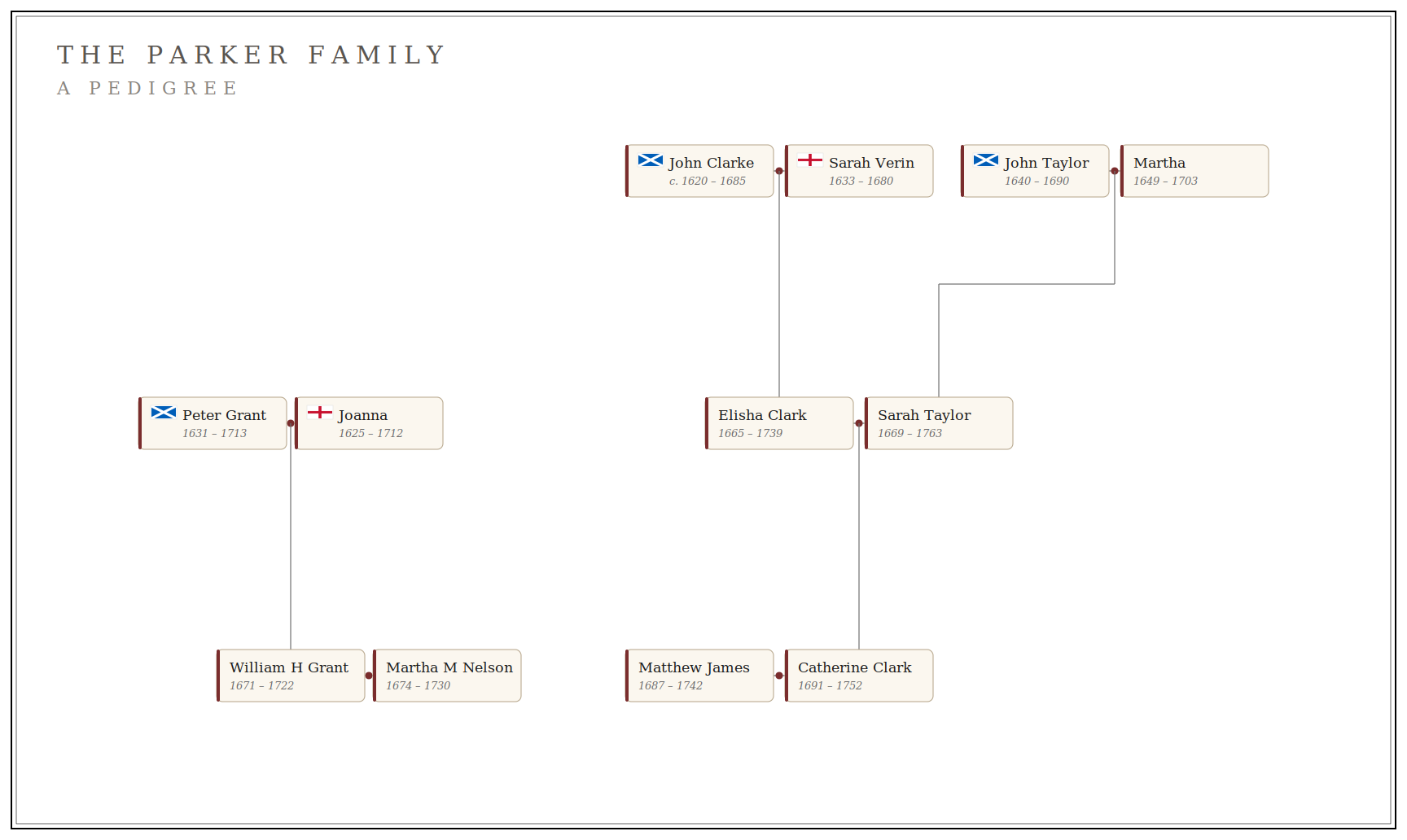
    Three of my great-nth-grandfathers — Peter Grant, John Clark, and John Taylor — crossed the Atlantic on the same ship, and not one of them chose to be on it.

    The ship was the Unity. It sailed from London in November of 1650 carrying a hundred and fifty Scottish prisoners of war, each under a seven-year sentence of labor, sold by the pound to a failing iron works outside Boston.

    To explain the prisoners, I should explain the war.

    Oliver Cromwell was a Puritan general who fought and won the English Civil War, beheading King Charles I in 1649, and abolishing the monarchy. His revolution made England a republic, with him at its head. He is the patron saint of “we killed the tyrant and managed to replace them with something worse.”

    When the dead king’s son inconveniently turned up in Scotland, the Scots raised him an army — out of a desire to both systematically piss off England and plant a Stuart on the throne who’d turn Scotland Presbyterian.

    Cromwell, never being much for competition, marched north to end the threat before it could come south. He found Charles II’s army at Dunbar, but managed to get himself pinned against the sea, with his army sick and starving, and a larger Scottish force on the high ground above.

    Then the Kirk’s ministers — who’d already purged the army of every officer they judged insufficiently godly — decided something like, “we need pious men more than competent ones,” and “who needs the high ground?”, and marched the Scots down off the hill, over General Leslie’s objections, to be routed by Cromwell’s veterans inside of an hour.

    Trust the Scots to snatch defeat from the jaws of victory.

    A few thousand Scots were taken prisoner and marched south — roughly a hundred miles, on foot, with no food. The jailer’s own letters record it: men who fell behind were shot, and the starving prisoners penned overnight in a walled garden dug up raw cabbages and ate them whole, mud and roots, which only killed them faster.

    They were held in Durham Cathedral, where dysentery and cold took some seventeen hundred more.

    (If that number feels abstract, it stopped being abstract in 2013, when a construction crew digging behind Durham Cathedral for a new café cut straight into a mass grave. The bones were the Dunbar prisoners — tipped in without ceremony, exactly where they’d died. It took until 2018 to rebury them properly.)

    The prisoners of war were, to the Cromwell regime, an asset that shouldn’t be wasted by slowly killing them in jail, and found themselves a London proto-capitalist named John Becx who owned a failing iron works at Saugus, north of Boston, that needed cheap hands.

    Becx bought himself a crop of unwilling Scottish prisoners, a hundred and fifty of the soundest, who were selected on the explicit standard of being “well and sound and free of wound.”

    He loaded them into the hold of the Unity and shipped across the winter Atlantic. Roughly one in ten died on the crossing. When the hold finally opened for good, three of my great-granddads climbed out of it.

    Peter Grant (1631–1713)

    Peter Grant was nineteen at Dunbar. He went first to the iron works at Saugus. It failed more or less continuously (it’s now a national historic site, which is what we do with businesses that lose money for a living) and he was sent north to the sawmills on the Piscataqua.

    He served out his time and then bought fifty acres of his own. The deed survives, and it names him “Peter Grant, Scotsman,” which in colonial Maine was half identification and half raised eyebrow. He’d come over with his brother James, also a prisoner on the Unity; and when James died, Peter married his widow, Joan, and kept the family on its land.

    John Taylor (1640–1690)

    John Taylor came off the Unity in the group sent up to the Great Works sawmill in what’s now South Berwick — about twenty-five Scots set to cutting the giant white pines the British navy wanted for masts. He served his indenture, took his fifty acres, and then the former prisoner — a man shipped here in irons by an English court — got himself appointed constable. And grand juror.

    But, he was not particularly solemn about it. In 1669, the York County Court formally admonished Taylor, along with a knot of his fellow Scots, for saying “the divell” too freely in everyday talk. You survive Dunbar, the march, the cathedral, the ocean, and seven years of bondage, and the colony’s official grievance against you is that you curse too much. His 1687 will left thirty acres to each of his five daughters, so he died with a good deal more land than he started with.

    John Clark (1620–1685)

    John Clark’s thread runs through his wife, and she gets the best entrance of the three anyway.

    In 1652 the Essex County court fined a young woman named Sarah Verin for the crime of wearing a silk hood. This was an actual offense: Massachusetts kept sumptuary laws reserving fine dress for the right rank of people, and someone had looked at the stepdaughter of an iron-works carpenter, decided she was dressing above her station, and reported her.

    Sarah, fined for the hood, married a Dunbar Scot bonded at the very iron works where her stepfather worked. Whether she meant anything by it, the record doesn’t say.

    Scots’ Charitable Society

    Then the part that warms my cold, jaded, progressive heart:

    In January of 1657, in Boston, twenty-eight Scotsmen signed a short plain agreement to keep a common box of money “for the releefe of our selves being Scottishmen or for any of the Scottish nation whome we may see cause to helpe.” Their indentures were just then running out — newly free, and immediately organizing to feed and bury one another, because nobody else would.

    That box is now the Scots’ Charitable Society, the oldest charitable organization in the Western Hemisphere. Three hundred and sixty-nine years later it still meets, and still gives money away.

    On the founding roster of twenty-eight names are Peter Grant, his brother James, and a John Clark, whom I’ve drawn the obvious conclusion is none other than my own great-nth-grandfather.

    I love the poetry of it. Men who had been sold off a dock a few years earlier put their names to the oldest charity on the continent.

    And one more line in the records closes the circle. Taylor’s daughter Sarah married Clark’s son Elisha. Two of these prisoners — off the same ship, scattered to different mills on the same river — became grandparents to the same children.

    It can’t have been an accident. The Scots that Cromwell flung across an ocean found each other on the Piscataqua and did the most durable thing a scattered people can do: they married their children to one another, deliberately, until “the Dunbar men” stopped being a cargo manifest and turned into a town.

    There are places on that coast — a Berwick, a Scotland parish in York — that exist because the plan to disappear these men failed.

    They were shipped over as the end of something — a defeated army, sold and scattered and entered in the books as property and labor and “Scotchmen.”

    Within seven years they had a charity. Within a generation, a neighborhood. Within ten generations, me — putting their names back into the world one generation at a time.

    Which is the one thing the people who loaded the Unity were trying to make sure they would never ever do.

    Sources. The Battle of Dunbar (3 September 1650), the forced march to Durham, and the 2013–2018 Durham Cathedral mass-grave excavation and reburial. The ship Unity — sailed November 1650 with ~150 prisoners consigned by John Becx to the Saugus Iron Works, selected as “well and sound and free of wound,” and the distribution of its men to Saugus and the Maine sawmills — from Saugus Iron Works records and the Scottish Prisoners of War Society. The Scots’ Charitable Society founding agreement of 6 January 1657 and its roster of twenty-eight names. York County, Maine deeds and probate — the “Peter Grant, Scotsman” deed, Grant’s marriage to Joan, Taylor’s constableship, the 1669 admonishment, and his 1687 will. Essex County, Massachusetts Quarterly Court records — the 1652 fine of Sarah Verin. Stackpole’s Old Kittery and the Genealogical Dictionary of Maine and New Hampshire for the Grant, Taylor, and Clark families.

  • In Case She Return: Bethia Payne (~1680–1724) and Dorothy Milbury (fl. 1692–1702)

    In Case She Return: Bethia Payne (~1680–1724) and Dorothy Milbury (fl. 1692–1702)

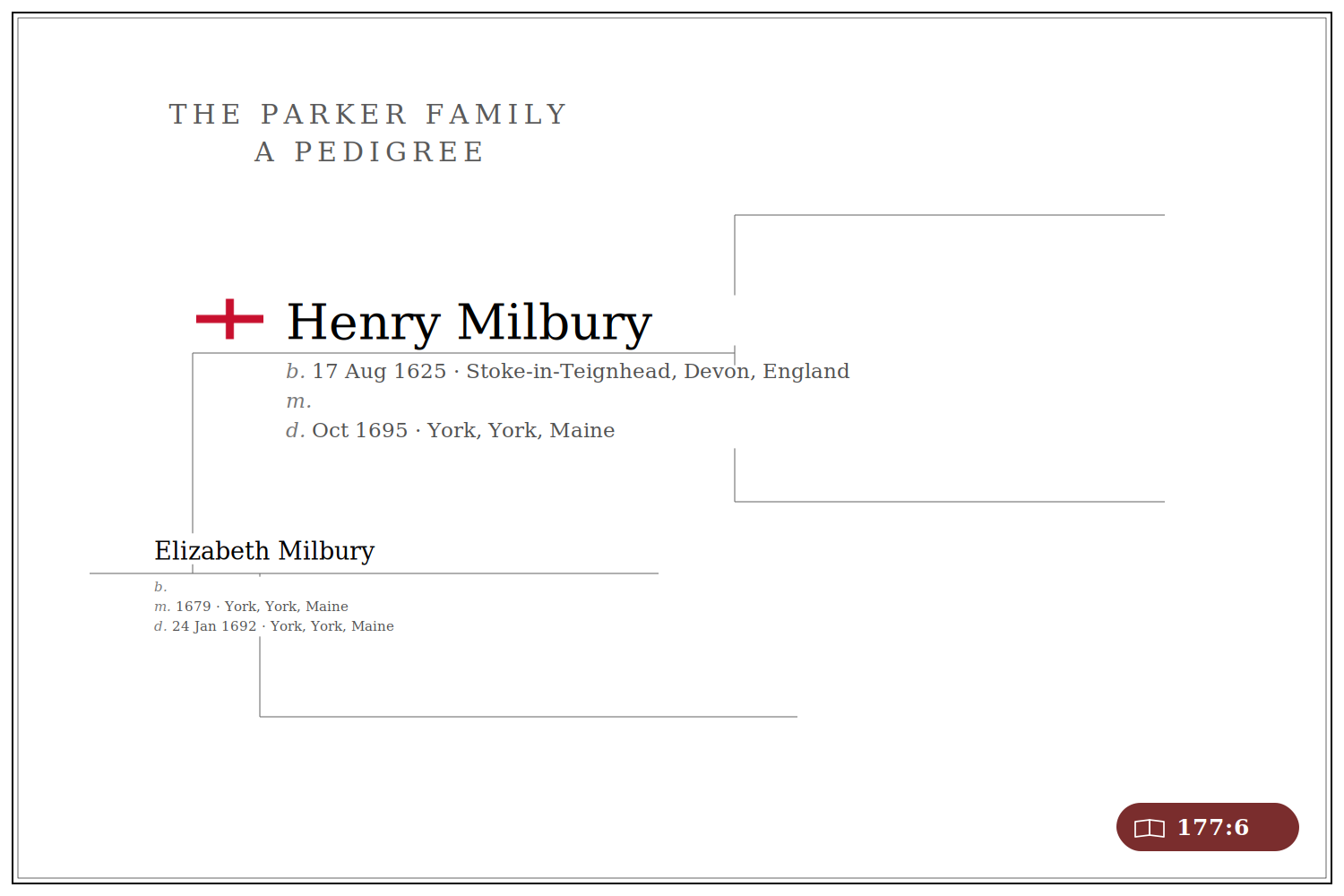
    In June 1695 an old man at York sat down to write his will, and somewhere in the middle of the bequests he had to make a decision most people never have to make.

    Henry Milbury had to decide what to leave a daughter he could not prove was alive.

    Henry was baptized at Stoke-in-Teignhead, in Devon, on 7 August 1625, son of a William Milbury about whom the record knows nothing but the name. He crossed the way half of coastal New England crossed — undramatically, unrecorded. He turned up at York, Maine, and married a daughter of one William Dixon.

    (Dixon is worth ten seconds on his own. He came over in 1630 as a servant to Governor Winthrop, and by 1635 he had jumped his bail. In January 1636/7 he bought a house at York and lived in it for thirty years — cooper, juryman, name on the tax lists, dead in bed with a will.

    Whatever the governor of Massachusetts wanted him for, nobody in Maine appears to have cared. If these people kept diaries about their feelings, they neglected to leave them somewhere I could read them.)

    Then Henry settled into the business of being one of a few thousand people living on the Maine frontier. He farmed on Alcock’s Neck. He took the oath of allegiance in the spring of 1680. He was granted twenty acres in 1691. That is very nearly the complete public record of sixty-six years, and it is the record of a man to whom nothing had happened.

    Then, at dawn on a Sunday in January 1692, that stopped.

    First, the calendar

    The record calls what happened that day the Candlemas Massacre, and the name needs ten seconds too, because it is not English.

    Candlemas is 2 February — the Feast of the Purification, forty days after Christmas, the day the church blesses the year’s candles. York did not keep it. Puritan New England had scrubbed the holy-day calendar down to the Sabbath and a couple of civil fasts, and 24 January 1691/2 was a Sabbath: the minister, Shubael Dummer, preached that morning to a congregation that had no particular feeling about candles.

    The French did keep it. And the French were on the Gregorian calendar, ten days ahead of the Julian one England was still using, so the day York experienced as Sunday 24 January was, to the men coming through the snow, 3 February — Candlemas and a day. The massacre is named for a feast the dead did not observe, on a calendar they did not use. The name arrived later, from the other side.

    Then, the raid

    Somewhere between 150 and 300 Abenaki and Canadians, under the Penobscot sachem Madockawando and the priest Louis-Pierre Thury, came into York through the snow and took the town apart. They burned the undefended houses along the north bank of the York River, which was where the town was. Dummer was killed.

    The dead were counted at about fifty by Banks, who assembled the casualty list; other accounts say a hundred, and the honest answer is that nobody knows. Roughly eighty people were marched north toward Canada, in Maine, in January.

    Henry Milbury lost most of his family between dawn and the end of that day.

    His daughter Elizabeth — killed. Her husband, Thomas Payne — killed. His brother Richard, who had been baptized in the same Devon parish sixty-three years earlier and had followed him to the same town — killed. His daughter Dorothy — taken. His granddaughter Bethia, eleven years old — taken. His grandson Samuel — taken, or so it was reported. His son William was already dead.

    Three and a half years later, nearing the end, he wrote his will. Not one of them had come back.

    The document

    When he came to Dorothy he could not write her down as living and could not write her down as dead, so he wrote her down as both:

    Unto my Deer Daughter now In Captivity with the Indians Dorothy Millbury I will & give the Summ of five pounds, In case she return by gods good Providence from captivity, but if not till then to be paid which Legacy I Intend not payable by my Son at all if she never return.

    A will is a document for settling known quantities. It exists to convert a man into a list. Henry got most of the way through his list and then hit a line item the form does not accommodate, and rather than guess, he wrote a contingency: five pounds, conditional on an outcome no one alive could report, payable never if the condition failed.

    A few lines down, three grandchildren. My two grand children Bethiah Pane & William millbury ten Shillings apeice. William was the son of the son who had died; he was in York, and could be handed the money. Bethia had been in Canada for three and a half years. They are named together anyway. My Grandson Samuell Pain the Sum of ten Shillings sits by itself, on its own line. Whether that means anything, I can’t tell you.

    The will was proved on 1 October 1695. Henry was dead inside four months of writing it, still holding the question.

    What nobody wrote down

    Which leaves seven years, and we do not know one thing that happened in them.

    Neither woman wrote anything down. Dorothy’s entire file is two entries — she appears as a captive on a numbered list of prisoners held in Canada, at page 78, and she is recorded as having returned. Bethia’s is a redemption date. Between the two ends of each there is nothing. No letter, no deposition, no line in a French parish register that anyone has yet turned up.

    What there is instead is a genre, and the genre is the reason we know anything at all about what those years were like for anybody. The captivity narrative: the ordeal, the providential hand of God, the spiritual lesson wrung out of the suffering. Mary Rowlandson published the template in 1682 and it sold like nothing else in the colonies. If you were lucky enough to come back, you gave the world your testimony.

    Neither of these two gave anybody anything. But other people did — from the same war, the same coast, and in some cases the same raiding parties — and while none of it can tell us what happened to Dorothy and Bethia, it tells us what the range was.

    Hannah Swarton was taken at Casco Bay in May 1690, twenty months before York, and walked to Quebec. She was put in Indian dress, one pair of shoes, no stockings, and the arrangement was that she kept their pace or was killed where she stopped.

    Her feet were cut by stones and by ice, and she said that many times she thought she could go no further, and that if they meant to kill her they could kill her. She was on the move from May to February. The York captives walked in January.

    What waited at the other end was not one thing. Swarton was handed along, begged provisions off a French housewife, and was eventually ransomed out of Abenaki hands by the wife of the Intendant of New France — the colony’s chief administrator, second only to the governor.

    She was given French clothes, taken to the hospital, bled and physicked and looked after, and made a servant in the house, and she said the French were as kind to her as she could have expected the English to be.

    She also spent five years under steady pressure to convert, which is the part Cotton Mather cared about when he printed her account in 1697. A good deal of the piety in the printed version is probably his rather than hers.

    John Gyles got both ends of it. Taken at Pemaquid in August 1689, aged nine: six years with the Maliseet, then sold on to a French seigneur on the St John River, then freed in June 1698 — one year before Bethia came home.

    He wrote his own account and published it in 1736, and it refuses to resolve into a thesis. It holds the French household that treated him decently at the end, and it holds his own brother, burned to death for trying to escape.

    And underneath all of it runs the thing the narratives are structurally incapable of showing you, because the people it happened to never came back to write one.

    A woman from Oyster River was taken in 1689 with two daughters, and all three of them stayed. The widow married Edward de Flecheur in Canada in 1710. Her daughter Judith, born 1676, was baptized there as Marie Magdeleine, married Jean le Conte in 1698, and was buried in 1703 — a whole adult life, in French, in the parish books of a country she had been carried into at thirteen.

    Swarton herself got out in 1695; her daughter Mary did not, and was rebaptized Marie Souart that February, and was still on the list of those left behind when her mother’s ship sailed.

    The pattern is age. Adults were ransomed, listed, exchanged and shipped home. Children taken young were absorbed — baptized, renamed, married into a parish — and after enough years there was no particular reason left to go. That was not the system failing. That was the system, and the paperwork is in French because the people ended up French.

    Bethia was eleven going in and eighteen coming out, which is precisely the profile that usually didn’t come out at all. Everything about her file says she should have become somebody’s Marie.

    So here is the entire honest contents of those seven years. Two women walked a few hundred miles in winter with the people who had just killed their family, lived through something in a small colony that had a documented interest in keeping them, and then declined to stay. Whatever was asked of them, they didn’t take it. I’d rather hand you the hole than fill it.

    Afterward

    Bethia was redeemed to Casco Bay in January 1698/9, after seven years, at eighteen — into a province that had burned down around her when she was a child. The war had ended by treaty the previous September, which is probably the mechanism: less bought back than handed back, in the general accounting.

    Dorothy came home too. The date isn’t in anything I’ve got — only that she returned, and that in October 1702 the York court recorded her marriage to John Grant. Which is the sort of ordinary sentence that only reads as a miracle in context. The five pounds became payable.

    And then the paper closes over her again. No death, no burial, no further entry of any kind. She outlived the worst day her town ever had, walked back out of Canada, got married, and the record lost interest in her.

    Samuel never appears again either. No Canadian record, no redemption, no return. The most likely reading of that silence is not a good one.

    Bethia had a testimony to give and a market ready for it. What she left is a conveyance. On 5 December 1711, thirty-one and single, she deeded her dead father’s 1683 land grant to her uncle Richard Milbury, with full warranty. It is the only document of hers we have. (Full warranty, too. She wasn’t leaving her uncle exposed to a title dispute.)

    She married Joseph Preble, born at York in 1691 and eleven years younger than she was — whose grandfather was the immigrant Abraham Preble, who reaches me twice: once here, on my father’s side, and once by a completely separate line down my mother’s to Nana, whose own mother was a Preble. Two arrivals, three hundred years, one man.

    A daughter, Hannah, in 1714. Bethia died at York in May 1724, around forty-four, in the town she had been dragged out of at eleven.

    She could have written the bestseller. The century wanted a testimony out of her and would have paid for one. She gave it a daughter and a deed instead. After what the records had already done to her family, I can see the appeal of being unremarkable on purpose.

    Sources. Genealogical Dictionary of Maine and New Hampshire (Noyes, Libby & Davis) — the Milbury, Payne, Dixon and Preble families, and the Canadian marriages and baptisms of captives who did not return. Henry Milbury’s will, 10 June 1695, proved 1 October 1695, York County probate (Maine Wills, 1640–1760) — the source of the clause the post is named for. Charles Edward Banks, History of York 1:271 — the raid and the casualty list. A Narrative of Hannah Swarton, printed by Cotton Mather in Humiliations Follow’d with Deliverances (Boston, 1697). John Gyles, Memoirs of Odd Adventures, Strange Deliverances, &c. (Boston, 1736). The Irving Preble Genealogy, register no. 19 — Bethia’s marriage to Joseph Preble and their daughter Hannah, 1714. The York County deed of 5 December 1711 by which Bethia conveyed her father’s grant.

  • The Charter and the Pond: Capt. Noah Wiswall (1638–1690)

    The Charter and the Pond: Capt. Noah Wiswall (1638–1690)

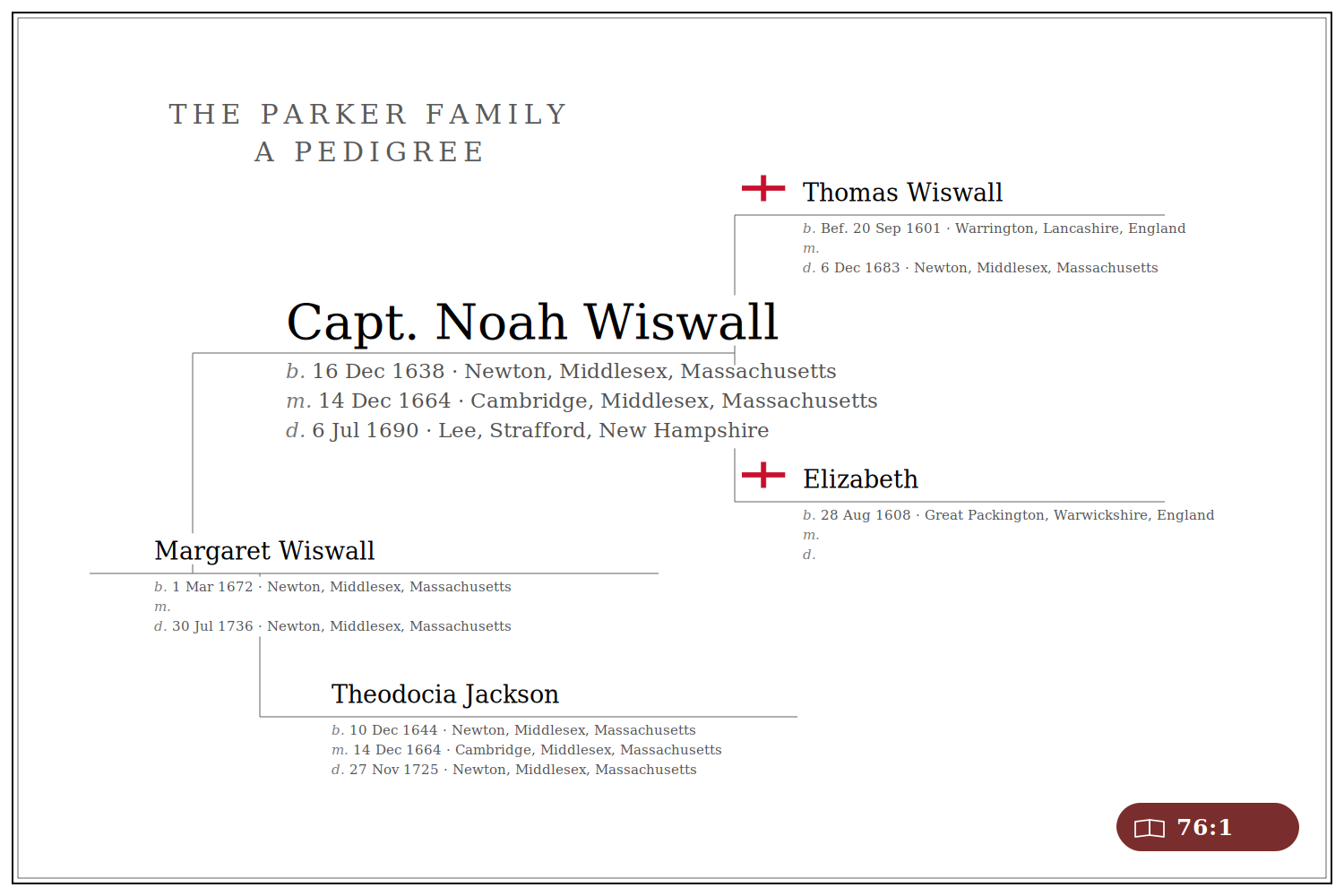
    Capt. Noah Wiswall (1638–1690) was fifty-one years old and had ten children the summer Massachusetts asked him to walk into the woods and go to war one more time.

    He said yes.

    He was a generation past the age when a man is expected to do this, he had a farm in what’s now Newton and a wife and a houseful of kids, and when the colony raised two companies to chase a French and Abenaki raiding party north, Noah took one of them.

    It was King William’s War — the European powers had decided to be at war again, which on the New England frontier meant France arming the Abenaki and the Abenaki fighting to keep the English from spreading any further across their lands.

    On 4 July 1690 a raiding party hit Exeter. Exeter held. The party fell back and made camp on the shore of a pond named for the Rev. John Wheelwright, in what is now Lee, New Hampshire. Those two Massachusetts companies went after them — one under Capt. John Floyd, one under Noah.

    His scouts found the trail at first light on 6 July. The militia came down on the camp and the thing turned into what the old accounts called “a running fight through the woods, after the Indian fashion.” When it was over, three officers and fifteen men were dead — Noah among them, along with his lieutenant Gershom Flagg and his ensign Edward Walker.

    And one of his sons. John Wiswall was about twenty years old and in his father’s company that morning, and he died there too.

    Theodocia Jackson Wiswall, forty-seven years old, buried her husband and her son on the same day, with five children still living and the youngest fourteen. She remarried four years later, the required next step for a woman of that time after doing the arithmetic of how to stay alive.

    The aftermath has its own grim comedy, if you want it. Floyd kept the field for hours after Noah fell, until enough of his men were dead or bleeding that he pulled the rest out — and was promptly second-guessed by people who weren’t there, for not staying longer.

    Capt. James Convers rode out at sunrise the next morning, found seven of the wounded still alive in the woods, carried them to a hospital, then went back to bury everyone else.

    The Charter

    By strange coincidence, while Noah was dying in those woods for Massachusetts Bay, his older brother was in London, losing a different fight to the same colony. The Rev. Ichabod Wiswall was the minister of Duxbury, Ma., down in Plymouth Colony.

    In February of 1690 — months before Noah marched — Plymouth scraped together the money to send Ichabod across the Atlantic to plead for a royal charter. Little Plymouth had never had one, and without it the colony was a legal ghost, eyeballed by its bigger neighbors. Ichabod went to London essentially to keep Plymouth on the map.

    On the other side was Increase Mather — the heaviest minister in New England — who was working the same court for the opposite result: fold Plymouth into Massachusetts Bay and be done with it.

    Two reverends from Dorchester, arguing over a colony’s life in front of the Crown. Mather won. The 1691 charter erased Plymouth and handed it to the Province of Massachusetts Bay — a hostile takeover with a king’s signature on it.

    One Wiswall brother dies in a Massachusetts Bay company defending Massachusetts Bay’s frontier. The other watches Massachusetts Bay swallow the colony he’d crossed an ocean to save. Both Wiswalls lost to the same flag in the same eighteen months.

    The Monument

    Newton put up a monument to its first settlers, and Noah is on it: “Capt. Noah, of the expedition against Canada, killed in battle with the French and Indians, 1690. Leaving a son Thomas.”

    Not to be salty, but Noah’s daughter Margaret is the reason I’m here. She married a Parker and carried the line out of that grief and down to me.

    He went into the woods at fifty-one and didn’t come back, and somewhere in the wreckage of that summer is a girl who would grow up and marry, ensuring her father was somebody’s ancestor instead of only a name carved on the south side of that monument.

    Yet the monument speaks of the son but fails to mention the daughter.

    Sources. The Wiswall Genealogy — descent and the Newton, Massachusetts marriage to Theodocia Jackson, 1664. WikiTree (Wiswall) and the Newton Vital Records — Noah’s children, including John, killed beside him, and the eldest son Thomas, named on the First Settlers Monument. Contemporary accounts of the Wheelwright’s Pond fight, 6 July 1690, and of Ichabod Wiswall’s charter agency in London.

  • The Talent for Not Dying: Reuben Wentworth (1729–1826)

    The Talent for Not Dying: Reuben Wentworth (1729–1826)

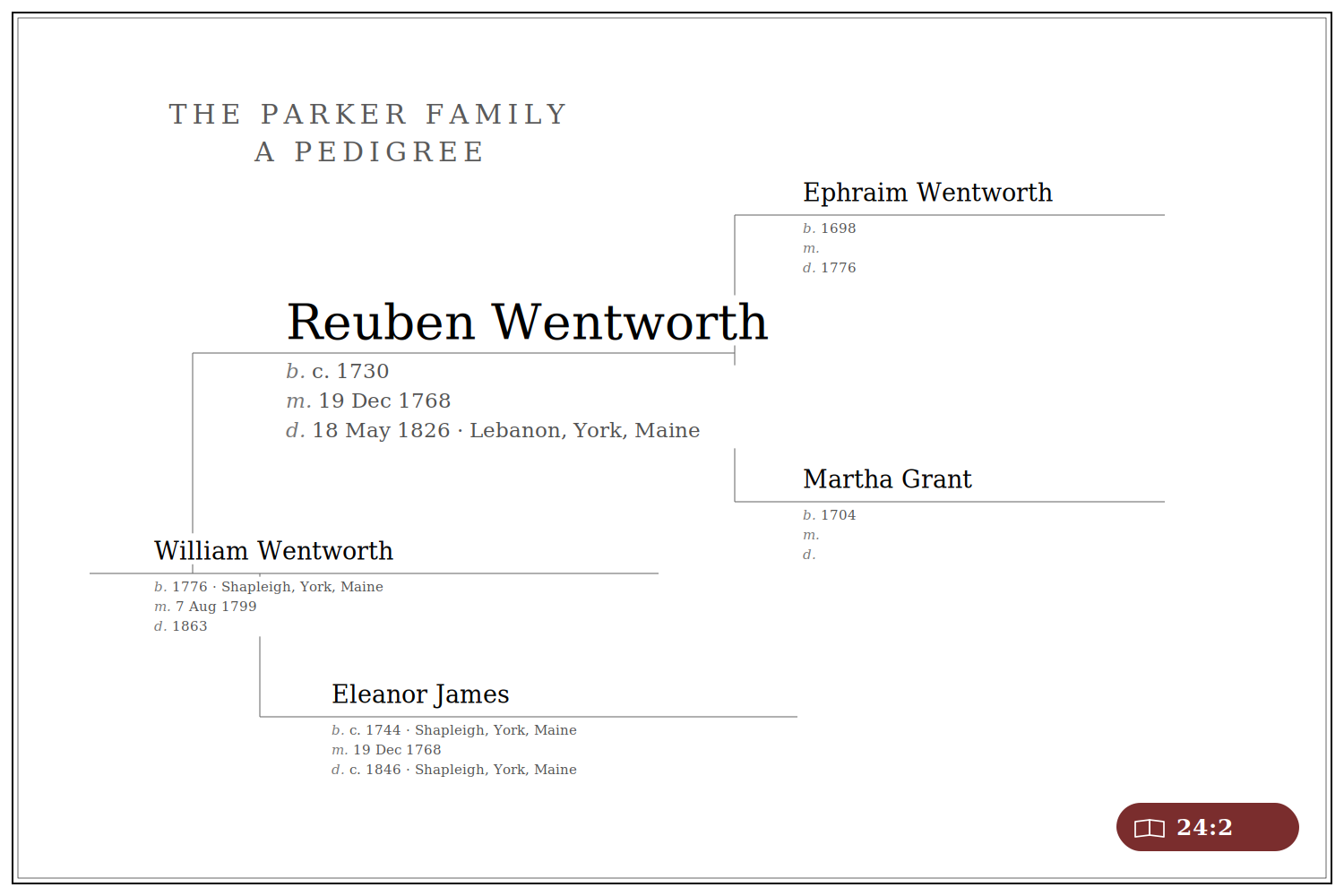
    Family legend says my five-times-great-grandfather Reuben Wentworth was at Bunker Hill.

    He was a forty-five-year-old farmer out of Shapleigh, in the District of Maine, which was not yet a state, just the far north end of Massachusetts. Most of the people who fought on the seventeenth of June, 1775, were half his age.

    The stories do not say which company Reuben fought with. This sounds like an unimportant distinction, until you realize that the two options means the difference between “standing on a different hill and listening to it” and “killing several hundred redcoats at forty yards.”

    To make matters more confusing, the Battle of Bunker Hill was apparently not fought on Bunker Hill. There are two rises on the Charlestown peninsula, and the militia were sent up to fortify the taller one in the dark. At sunrise, they found themselves dug in on the shorter one: Breed’s.

    Nobody has bothered to correct the name of the battle in two hundred and fifty years. File that away. It comes back under oath.

    The 30th Maine

    Maine sent exactly one regiment to the war that year: Col. James Scamman’s 30th Regiment of Foot, raised out of York County — Kittery, Berwick, York, Wells, Arundel. Reuben’s neighbors, more or less. A return of 9 June puts it at three hundred and ninety-six men fit for duty.

    On the seventeenth they marched toward the guns. They did not arrive.

    Somewhere on the Cambridge road they met two men on horseback who said the regulars were landing at Lechmere’s Point, so the regiment went to Lechmere’s Point. There they ran into Col. John Whitcomb, who was acting as a general officer that day, and who testified against them the following month:

    “I asked him what brought him there, he replied by asking me where he should go. I told him where he could do the most service.” Two colonels in a field, one asking the other for directions to the largest event of both their lives.

    Scamman understood the answer to mean a hill. There are, in the vicinity, several. He picked a small round one a mile off and stood on it watching the British floating batteries.

    How long he stood there is the single most disputed fact in the record. A quarter of an hour, said one ensign. Twenty minutes. Half an hour. Half an hour or more. Three-quarters, said the major, the drummer and the adjutant.

    At some point Scamman sent two sergeants over to Bunker Hill to ask whether his regiment was “wanted.”

    Then Charlestown caught fire, and that finally did it. Scamman saw the meeting-house burning, and he marched the regiment up Breed’s Hill with all possible dispatch, going in under fire, with the shot flying thick.

    Scamman shouted the line he is now stuck with forever: “Come, my Yorkshire lads, now let us show our bravery.”

    Unfortunately, his timing wasn’t great. He was shouting the line that would outlive him at a hill the battle had already finished with. Men were coming down past them, saying they had spent all their ammunition. Scamman ordered a retreat and, according to one soldier, “every one made the best of his way off.”

    Even a month later, those involved didn’t know the difference between Bunker’s Hill and Brewer’s Hill. Everybody in that transcript means Breed’s. Nobody in it says Breed’s.

    Scamman’s court-martial convened 13 July 1775 on a charge of disobedience to orders and backwardness in the execution of his duty in the late action on Bunker’s-Hill. He was acquitted, but was out of the army before the year turned.

    In testimony, a Major Daniel Wood was called, and the record notes that the Major could not say any more upon the case, “for he was not so happy as to reach Bunker’s-Hill for the whole day.”

    Major Wood lived in Shapleigh.

    The 1st New Hampshire

    If family legend suggests Reuben actually fought in the battle, we’d have to assume he marched with his western neighbors.

    Shapleigh sits on the New Hampshire line. Rochester is a morning’s walk. Men crossed that border for work, for wives and for regiments — Reuben himself married Eleanor James in December 1768 at Somersworth, on the New Hampshire side.

    New Hampshire sent Col. John Stark.

    The American line on Breed’s Hill ended in the air on the left. Capt. Thomas Knowlton saw it and took his Connecticut men down behind a farm fence — half stone, two rails of wood — six hundred feet back from the redoubt, threw up a second fence in front of the first.

    It looked like a breastwork. It wasn’t — in plain words it gave no defensive cover, since all they had to close the gaps in the fence was newly cut hay.

    Col. Stark and the bulk of his regiment arrived between two and three o’clock, crossing Charlestown Neck while the ships and shore batteries raked it end to end.

    When he arrived, he looked at the ground and saw the thing nobody else had. The fence stopped at the top of the bank. But, below the bank, at low tide, lay a strip of Mystic River beach — a clear road, wide enough to walk a column down.

    So he ran the fence down the bank, and at the bottom his men threw the beach stones into a wall to the water’s edge, in about the time it takes to describe it.

    Then John Stark took a stake, walked out in front of his own line thirty or forty yards, drove it into the sand, and told his men: “Boys, the red coats are coming up the hill. If one of you fire a gun till they reach that stake, I’ll shoot him.”

    (That one reaches us third-hand — Caleb Stark had it from George Washington Parke Custis, who said he had often heard Washington tell it. Which is a game of telephone, but with the Father of His Country on one end of the line, so I am pretending like it is gospel.)

    The British right came down the beach in column at a run — the light infantry, the best they had.

    A British officer wrote home two weeks later that their light infantry were served up in companies against the grass fence, without being able to penetrate. Most of the grenadiers and light infantry, he wrote, lost three-fourths of their men the moment they presented themselves, and many lost nine-tenths. Some companies came out of it with eight or nine men. Some came out with three.

    The next morning, Gen. Winslow of Boston walked the ground at ten o’clock, before anything had been buried, and counted ninety-six dead in front of that little stone wall on the sand.

    None of which was winning the battle. Half a mile to the right the men in the redoubt were down to a round apiece, and Howe sent the third assault in with orders to leave the muskets alone and use the bayonet.

    The redoubt fell that day. The rail fence did not. It held long enough for the men coming off Breed’s Hill to get across the Neck, which is the only reason that day was a retreat and not an annihilation. Stark pulled his people out in good order and had to stop them going after the British rear on the way, because they had thrown the attack back so many times they thought they had won.

    Then he went home

    Let’s be honest about how family legends work.

    If Reuben had been down on that beach with 1st New Hampshire, we would know it — fame and glory are not things a family loses track of.

    What was passed down through generations was totally devoid of any specifics. In my limited experience, a legend that vague is only vague because nothing in it is worth inflating.

    So my money is on Reuben being with the 30th Maine and the little round hill. Either way, he got back to Shapleigh and lived another fifty-one years.

    Longevity, not military service, seems to be the fact this family was most interested in keeping. The Wentworth Genealogy of 1878 mentions Reuben made ninety-six, and the book says his widow made it past a hundred.

    The rest of his years weren’t any easier than his day in, on or around Bunker Hill.

    In Reuben’s sixties, the sea took three of his sons. Reuben Jr. fell from a mast at Wells about 1794. Enoch and John shipped out of Boston in 1797 and did not come back.

    The son who carried the line to me was William, born at Shapleigh on 24 July 1776 — thirteen months after the hill, and twenty days after the founding of the country. William’s daughter Sarah was born at Lebanon, Maine, in 1802 and married a Parker.

    (William died in 1863 at Grimsby, Ontario, which, for what it’s worth, I am choosing not to read anything into.)

    Reuben Wentworth died at Lebanon, Maine, on 18 May 1826, fifty-one years and eleven months after the hill — the part of his life that got remembered, whether true or not.

    Sources. The Wentworth Genealogy (1878), v.1 no. 263 — Reuben and Eleanor, their marriage in 1768, his death at Lebanon on 18 May 1826, her death past a hundred, and the three sons the sea took. It is also the family’s authority for Reuben at Bunker Hill. Nathan Goold, History of Col. James Scamman’s Thirtieth Regiment of Foot (Maine Historical Society, 1899) — the York County regiment, the return of 9 June 1775, and the minutes of the court-martial of 13–17 July 1775 as Scamman himself published them in the New England Chronicle or Essex Gazette, bracketed remarks and all. Richard Frothingham, History of the Siege of Boston (1851) — Knowlton’s hay-stuffed rail fence, Stark’s stone breastwork on the Mystic beach, and the British letters on what the light infantry lost there. Caleb Stark, Memoir and Official Correspondence of Gen. John Stark (1860) — the crossing of the Neck, the stake in the sand and its chain of custody, and the ninety-six counted dead the following morning. Maine and New Hampshire vital records — the 1768 Somersworth marriage, and the descent through William Wentworth (1776–1863) and his daughter Sarah (1802–1891).